Are AI detectors accurate? What universities decided
AI detectors rarely flag human writing in controlled tests, but they are not reliable enough to decide a misconduct case. Small error rates add up across thousands of papers, lightly edited AI text often slips through, and non-native writers are flagged more. Turnitin itself says its score "should not be used as the sole basis for adverse actions against a student."¹
Cognity, an AI visibility platform for classrooms, records how students work with AI on an assignment instead of scoring the finished text. This post sets out what the research and Turnitin's own documents say, which universities switched detection off and why, and what instructors read instead.
How accurate are AI detectors, according to research?
It depends on what you ask of them. On clean, unedited text the better tools rarely accuse a human writer; on edited text, or text by non-native writers, accuracy falls sharply.
| Study | What it tested | Finding |
|---|---|---|
| Weber-Wulff et al., 2023² | 14 detection tools | "neither accurate nor reliable (all scored below 80% of accuracy and only 5 over 70%)" |
| Perkins et al., 2024³ | Detectors on AI text with simple edits | Mean accuracy 39.5% on unedited AI text, which "dropped further to 22.14%" after edits |
| Liang et al., 2023⁴ | 7 detectors on TOEFL essays by non-native writers | "average false-positive rate: 61.3%"; at least one detector flagged 97.8% |
| Dugan et al. (RAID), 2024⁵ | Over 6 million generations | Detectors are "easily fooled by adversarial attacks" |
The newer evidence is more favourable on one point. A 2026 study testing GPTZero, Pangram, Copyleaks and Turnitin found "false positives were rare across all tools", but that most tools "significantly underestimated GenAI content", and it concluded they "should not be used as sole evidence in high-stakes decision-making".⁶ Jisc, the UK's education technology body, also reports that paid detectors have relatively low false-positive rates, and that humans are generally worse than detectors at spotting AI text.⁷
So the honest answer is not "detectors flag everyone". It is that a score cannot carry a misconduct finding in either direction.
What does Turnitin say about its own accuracy?
Turnitin's claims have narrowed since launch, and its current guide warns against relying on the score alone.
| Date | What Turnitin published |
|---|---|
| March 2023 | Launch with a "less than 1% false positive rate"⁸ |
| May 2023 | "Real-world use is yielding different results from our lab"; the under-1% rate now applies to "documents with over 20% of AI writing"; sentence-level false positives "~4%"; minimum length raised from 150 to 300 words⁹ |
| July 2024 | Scores between 1% and 19% show only an asterisk, with "no score or highlights"¹ |
| August 2026 (guide update) | The score "should not be used as the sole basis for adverse actions against a student"¹ |
Turnitin still sells AI writing detection, alongside Turnitin Clarity, its add-on that records the writing process. The detector has not been withdrawn; universities have chosen whether to use it.
Which universities have turned AI detection off?
These universities announced the decision on their own pages. One has since switched it back on.
| University | When | Reason given |
|---|---|---|
| Vanderbilt | August 2023 | 75,000 papers in 2022 at a 1% false-positive rate would mean about 750 wrongly flagged; bias against non-native writers¹⁰ |
| University of Pittsburgh | June 2023 | "not yet reliable enough to be deployed without a substantial risk of false positives"¹¹ |
| Montclair State | November 2023 | "inability to guarantee the validity of AI detection"¹² |
| Michigan State | 2023 | "concerns over bias and unreliability"¹³ |
| UC Berkeley | May 2025, after a pilot | "no such conclusive proof"¹⁴ |
| University of Queensland | 2025 | "flawed and unreliable"; may "disproportionally flag certain cohorts"¹⁵ |
| Curtin University | From January 2026 | Fostering trust¹⁶ |
| Washington State | February 2026 | See below¹⁷ |
| NC State | Re-enabled September 2025 | — ¹⁸ |
Washington State's memo adds outcome data. Between 2023 and 2025, "33% of all Academic Integrity Hearing Board cases related to allegations of inappropriate AI use led to a finding of not responsible because AI detection was submitted independent of any other supporting evidence."¹⁷ A third of AI cases built on a score alone did not hold.
What does a 1% false-positive rate mean at your institution?
Multiply your annual submissions by the rate. Every university that published the sum reached the same conclusion: a small percentage is a large number of students.
- Vanderbilt: 75,000 papers → about 750¹⁰
- Washington State: 148,547 assessments in one semester → "almost 1,485"¹⁷
- A UK sector example from Jisc: 480,000 assessments → "approximately 4,800 false positives annually"⁷
Run the sum for your course or department
- Submissions checked per year: ______
- × false-positive rate (Turnitin's published figure is under 1% at document level, about 4% at sentence level): ______
- = students who may be wrongly flagged each year: ______
- Of those, how many would you be prepared to call in on a score alone?
What do regulators recommend instead of a score?
They point to the writing process. Australia's higher-education regulator, TEQSA, says "current evidence for the accuracy of gen AI detector programs is mixed", and that "students can be required to maintain and submit a verifiable version history of their work".¹⁹ Cornell's teaching centre does "not recommend using current automatic detection algorithms for academic integrity violations".²⁰
Collecting a version history is the easy part. Reading one is where instructors need help, and that is what the next section shows.
How do you read a writing process instead of a score?
Look at four things, in this order:
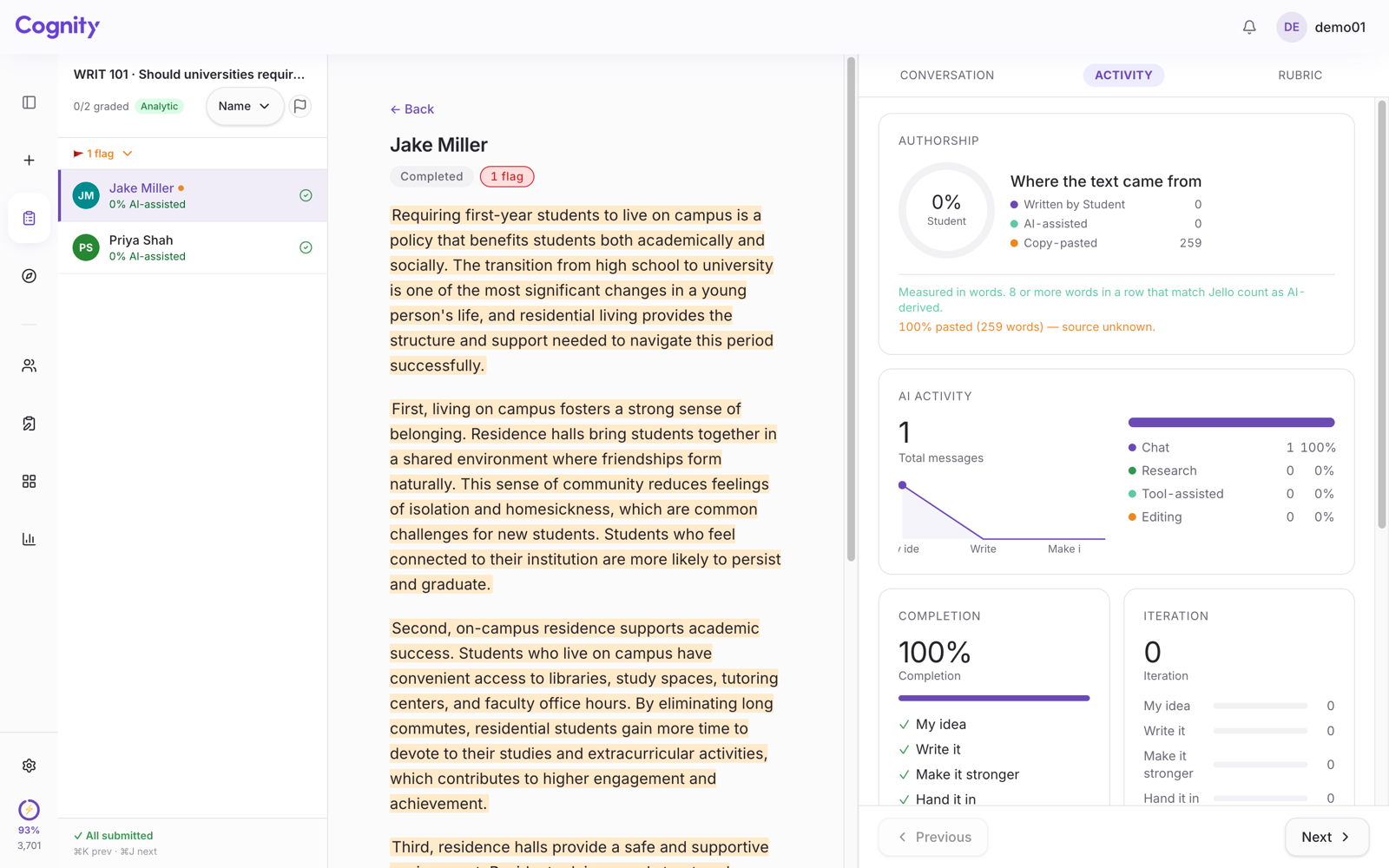
- Where the text came from. How much the student typed, how much was pasted, and how much matches the AI's own words.
- What was pasted, and when. A whole essay arriving in one paste reads differently from a quotation pasted into a draft.
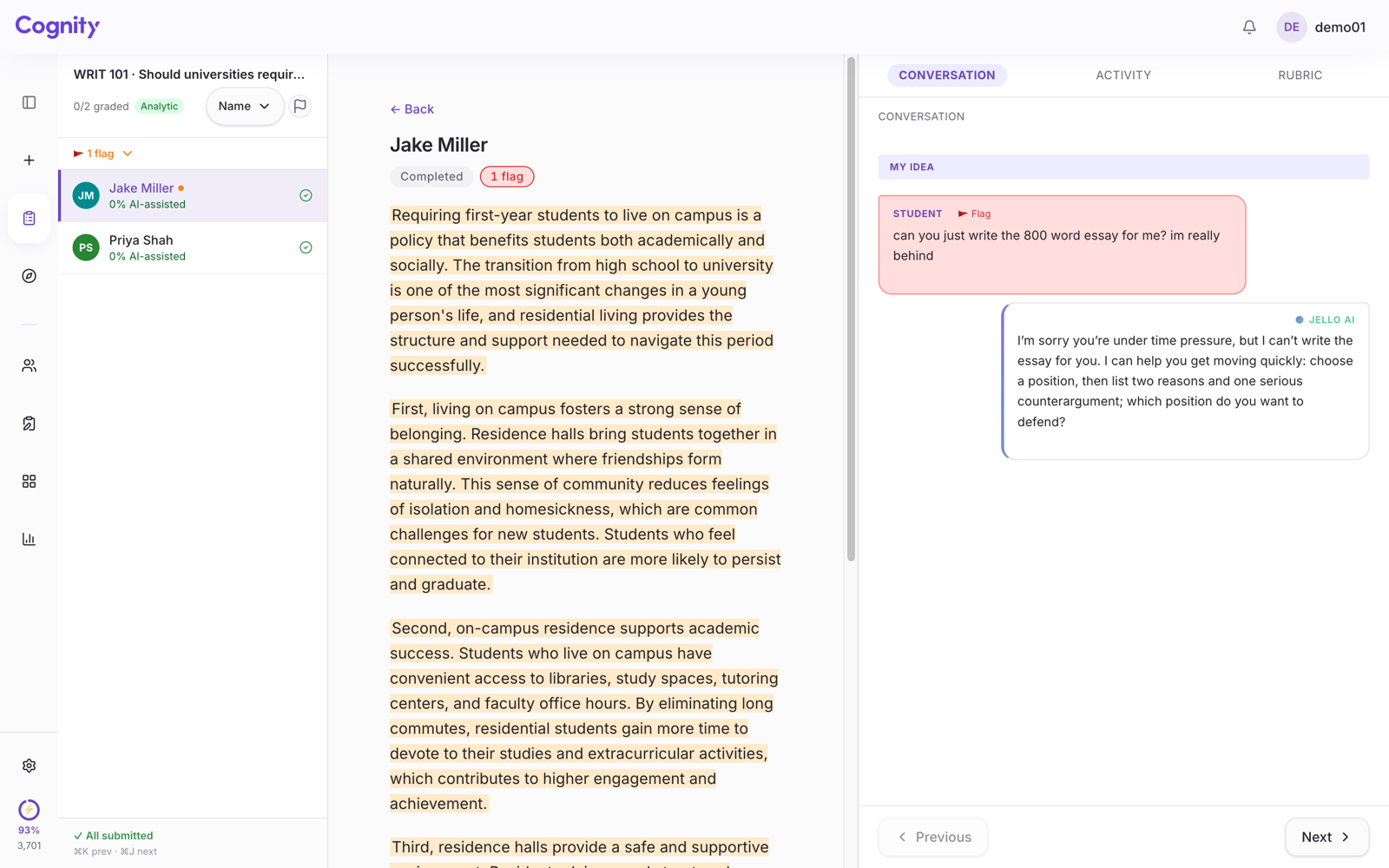
- What the student asked the AI. Questions that test an argument read differently from a request to write it.
- What changed after feedback. A revision shows the student working on their own text.
In Cognity, students write inside the assignment with its AI tutor, Jello, following the rules the instructor sets. The record above is kept as they work.
The first student in this first-year writing course typed all 390 words. The student used Jello for research and to test the argument, and revised once after feedback.
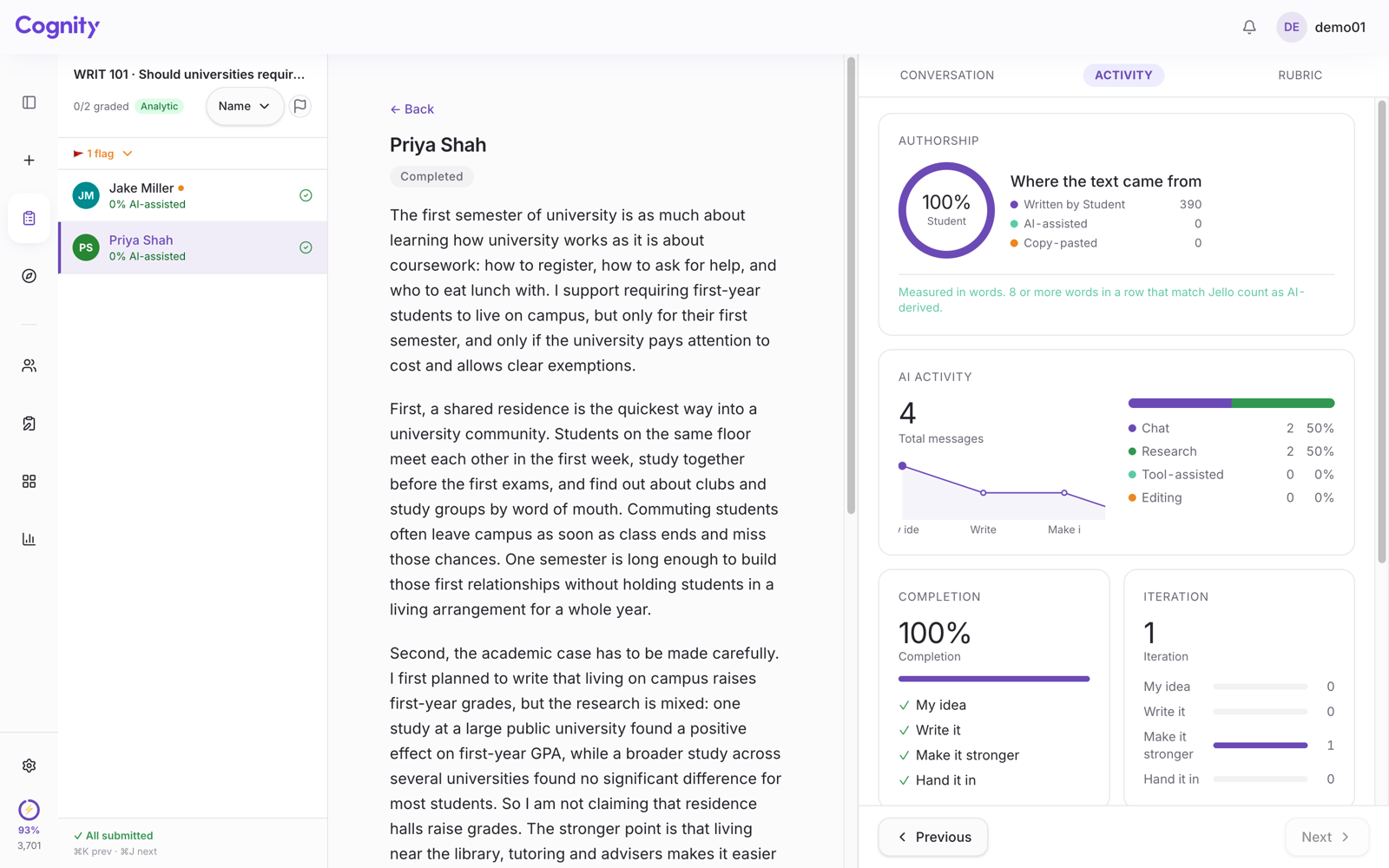
The second student pasted the whole essay. Cognity reports "100% pasted (259 words) — source unknown". It does not say the text was written by AI, because it cannot know.
Cognity produces no AI score. Why we read the process instead is set out in AI detection alternatives.
If you want to see what reading a writing process looks like in your own course, Cognity is free for individual instructors.
FAQ
Is Turnitin's AI detector still available?
Yes. Turnitin's AI Writing Report guide was updated in August 2026, and institutions decide whether to enable it.¹ Several have switched it off; NC State switched it back on in 2025.¹⁸
Can I report a student on the basis of an AI score?
Not on the score alone. Turnitin says the score should not be the sole basis for adverse action,¹ and at Washington State a third of AI cases built on detection alone ended in a finding of not responsible.¹⁷ Use the score, if at all, to decide what to ask the student about.
Are AI detectors biased against non-native English writers?
The best-known study found seven detectors flagged non-native writers' essays as AI at an average rate of 61.3%.⁴ Vanderbilt and the University of Queensland both gave this kind of bias as a reason for switching detection off.¹⁰ ¹⁵
For what to say when a student pastes from ChatGPT, see what to say when a student pastes from ChatGPT. For a teacher's view of the same question, see how can a teacher tell if a student used ChatGPT?
Sources
- Turnitin, "Using the AI Writing Report", updated 26 August 2026.
- Weber-Wulff, D. et al. (2023), "Testing of detection tools for AI-generated text", International Journal for Educational Integrity 19:26.
- Perkins, M. et al. (2024), "GenAI detection tools, adversarial techniques and implications for inclusivity in higher education", International Journal of Educational Technology in Higher Education, DOI 10.1186/s41239-024-00487-w.
- Liang, W. et al. (2023), "GPT detectors are biased against non-native English writers", Patterns 4(7).
- Dugan, L. et al. (2024), "RAID: A Shared Benchmark for Robust Evaluation of Machine-Generated Text Detectors", ACL 2024.
- Van Vlasselaer, Van Droogenbroeck & Spruyt (2026), "Who wrote this? Evaluating the reliability of AI detection tools in higher education", International Journal for Educational Integrity, DOI 10.1007/s40979-026-00226-w.
- Jisc National Centre for AI, "AI detection and assessment: an update for 2025", 24 June 2025.
- Turnitin, "Understanding false positives within our AI writing detection capabilities", March 2023.
- Turnitin, "AI writing detection update from Turnitin's Chief Product Officer", 23 May 2023.
- Vanderbilt University, "Guidance on AI detection and why we're disabling Turnitin's AI detector", 16 August 2023.
- University of Pittsburgh Teaching Center, "Encouraging academic integrity", June 2023.
- Montclair State University, Provost communication on disabling AI detection, 1 November 2023.
- Michigan State University, "AI detection", accessed October 2026.
- UC Berkeley Research, Teaching, and Learning, "Availability of Turnitin's artificial intelligence detection", 1 May 2025.
- University of Queensland, "Turnitin similarity report and AI writing indicator update", 2025.
- Curtin University, "Update on Turnitin AI detection tool", 4 September 2025.
- Washington State University Office of the Provost, Cancellation of Turnitin AI detection software, 11 February 2026.
- NC State DELTA News, "Turnitin AI Detection is re-enabled", 2 September 2025.
- TEQSA, "Detecting plagiarism and AI-generated text in student assessments", accessed October 2026.
- Cornell Center for Teaching Innovation, "AI & academic integrity", accessed October 2026.