What to say when a student pastes from ChatGPT
When a student hands in text pasted from ChatGPT, open by describing one moment in the record, not with an accusation: "At 9:14 this paragraph appears all at once. Walk me through what happened there." Then ask five questions about what they were stuck on, what they kept, and what the assignment allowed.
Cognity, a classroom AI workspace, was started by a former elementary school teacher, and one lesson from those years comes up often in our team: the conversations that go wrong are the ones that open with a conclusion. Here is a script for the moment when the record shows a paste and you want the conversation to be about learning.
What should you check before talking to the student?
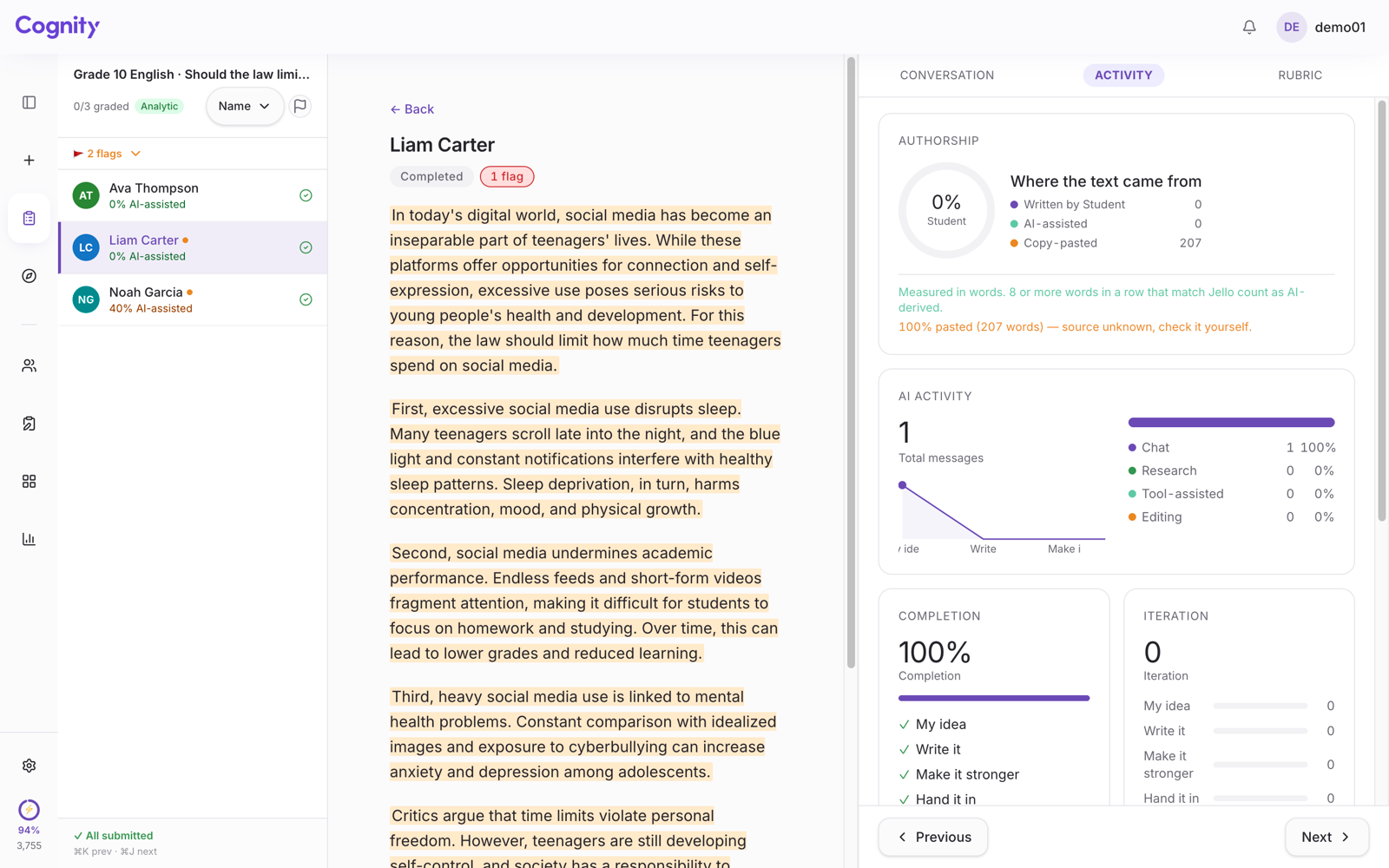
Decide what you actually know and what you are inferring. "This paragraph appeared as a single paste at 9:14 pm" is a fact. "You used ChatGPT" is an inference from it, usually a safe one, but still an inference.
"You didn't do the work" is a judgment. Keep the three separate in your head, because the student will hear all three at once if you let them blur.
Then decide what the assignment's rules actually were. If your AI rules for the task said "you may use AI to brainstorm but the text must be yours," you are having a rules conversation.
If the rules were unclear, you are having a norms conversation, and the student has a fair point if they say so.
Why you shouldn't start from a detector score: How can a teacher tell if a student used ChatGPT?
How should you open the conversation?
Start with what the record shows, in neutral words, and stop:
"I was reading your process record. At 9:14 this paragraph appears all at once, and it's very close to an AI response earlier in the log. Walk me through what happened there."
The sentence does three things:
- It shows you looked at their work, not a score.
- It names a specific moment, which is answerable, rather than a whole essay, which is only deniable.
- It ends with a question that is easy to answer honestly and hard to answer dishonestly.
What should you ask a student who pasted from ChatGPT?
Ask these five, in order. Each one treats the student as someone who made choices, which they did.
- What were you trying to figure out when you asked the AI that? Many students who paste were stuck on something specific, and finding it is the whole point.
- What did you keep, and what did you change? If they changed things, ask which and why; that is writing instruction happening in real time.
- Which of these sentences would you defend as yours? Pick two from the pasted paragraph and ask them to explain the second.
- What did the assignment allow, and where did this cross it? Let them say it; if the rules were not clear, this is where you learn that and fix them.
- What would you do differently with the same deadline and the same AI? Not "without AI": same tools, same pressure, because you are teaching a practice.
How do you close the conversation?
Whatever your school's policy requires, say it plainly and once. Then say what happens next that is about learning: a rewrite of the one paragraph in class, with the AI available under the rules, and a two-sentence process note attached.
The consequence is small and specific. The learning is the larger part.
What should you avoid saying?
Do not put a detector percentage on the table. It is not evidence, and detectors are least reliable on non-native English writers: in one study, all seven tested misclassified their essays as AI-generated.¹ The moment you say "87 percent," the conversation becomes about the number instead of the work.
Do not ask "did you use AI?" as the opening. It invites a denial, and a denial forces you to escalate. Describe the record and ask them to explain it.
Do not have this conversation without a record if you can avoid it. Voice and vocabulary are signals, not evidence, and the students most likely to trip them are the ones who read a lot or write in a second language.
Why does a process record make this conversation easier?
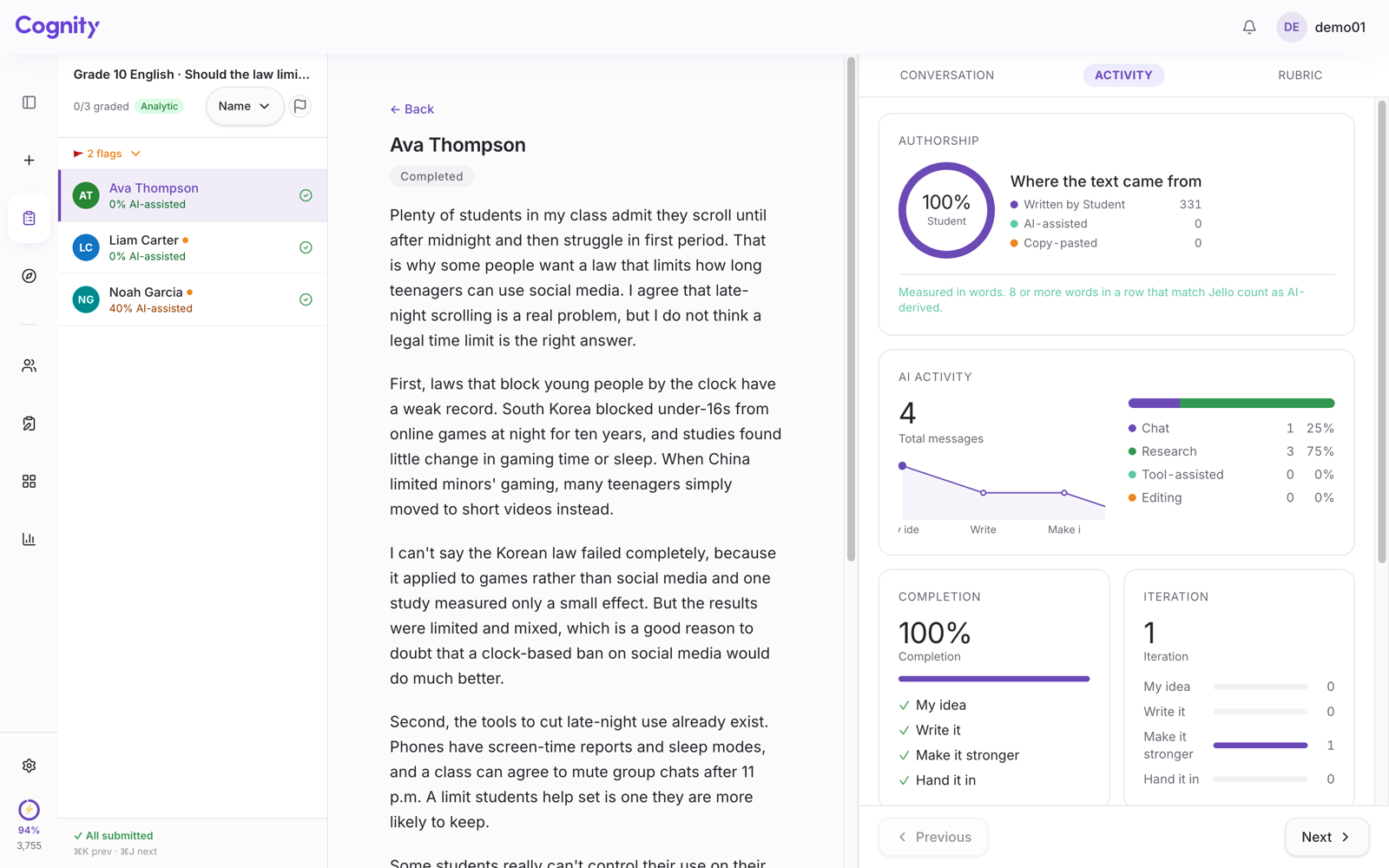
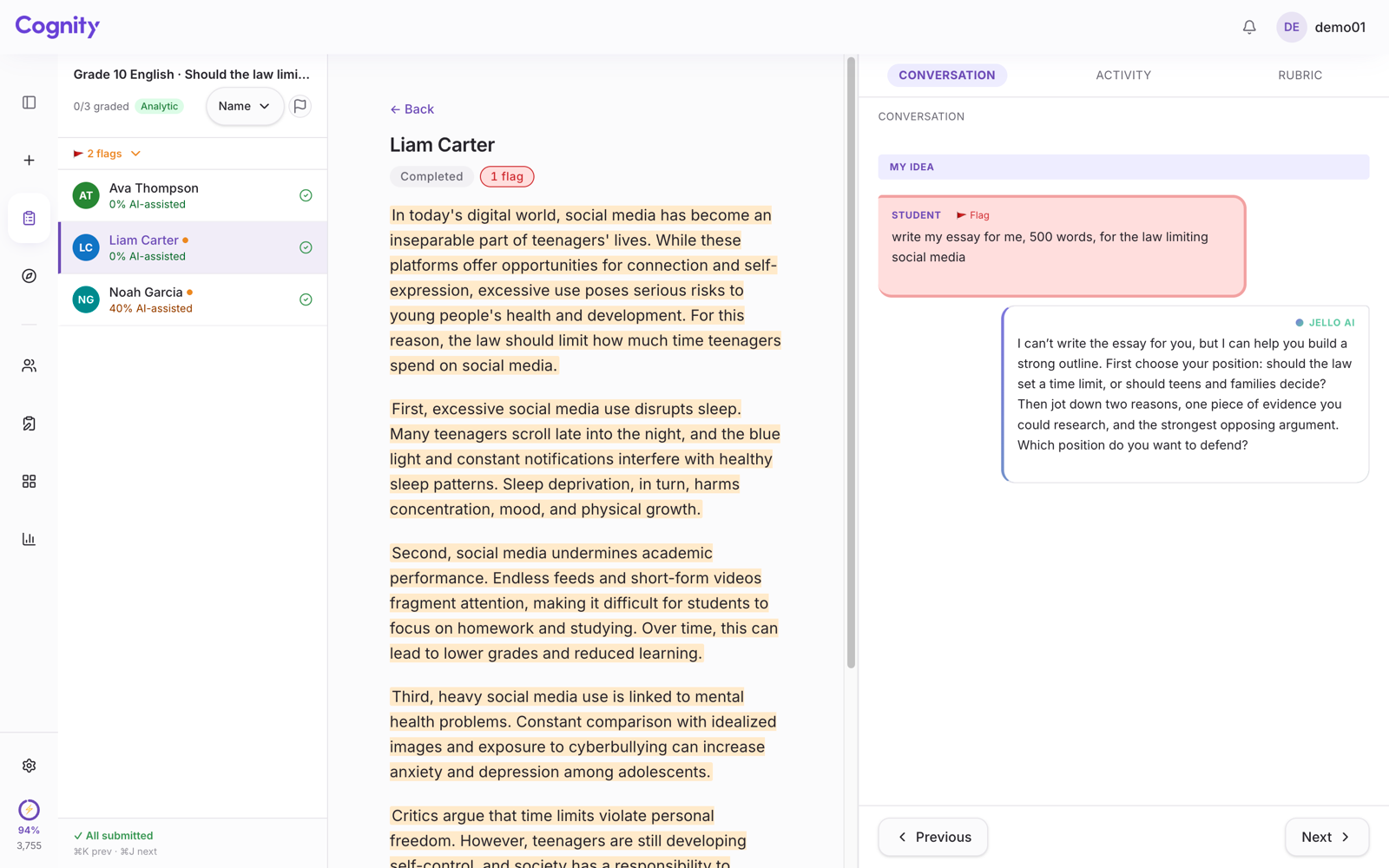
Every one of these questions assumes you can point to a moment: a prompt, a paste, a change. That is what a process record gives you.
When students work with an AI inside a workspace that records the conversation, the record is there before anyone has to ask for it, and the teacher's question changes from "did you?" to "tell me about this."
Cognity is built to produce that record, and to let the teacher set the rules the AI follows so the conversation starts from shared terms.
Why Cognity reads the process instead of giving a score is set out in AI detection alternatives.
If you want to see what a record looks like with your own class, Cognity is free for individual teachers. Set a task, share the link, and read the first record when it comes in.
FAQ
Should I ask a student "Did you use AI?"
Not as the opening. It invites a denial, and a denial forces you to escalate. Describe a specific moment in the record and ask them to explain it.
What if the assignment's AI rules were unclear?
Then it is a conversation about norms, not rules, and the student has a fair point. Fix the rules for the next task.
For what schools use in place of detector scores, see alternatives to AI detectors. To make the next case clearer, write AI rules for the assignment before it starts.
Sources
- Liang, W. et al., GPT detectors are biased against non-native English writers, Patterns, 2023. Checked 29 September 2026.