How can a teacher tell if a student used ChatGPT?

Short answer: from the finished text alone, you usually can't, not reliably, not fairly, and not in a way you could defend to a parent. AI detectors don't change that. What a teacher can read instead is the process: the prompts a student typed, what the AI answered, and what they kept or changed.
Cognity, a classroom AI workspace, was started by a former elementary school teacher. This is the answer we would want in the classroom, rather than the one that sells a product.
Can a teacher tell from the writing style?
Not reliably. Experienced teachers do notice things, and these are real signals, worth a conversation:
- A sudden change in voice
- Vocabulary the student has never used in class
- Paragraphs that are perfectly balanced but say nothing specific
- Citations that look plausible and don't exist
They are not evidence. A student who has been reading more, or who got help from an older sibling, or who is writing in their third language, produces exactly the same signals.
If you accuse on the basis of "this doesn't sound like you," you will sometimes be right, and you will sometimes be doing real damage to a student who did the work.
Why AI detectors don't solve this
Detectors only estimate a probability about the text, and they are wrong often enough, and unevenly enough, to be unfair. Three problems follow.
First, they are wrong often enough to matter. OpenAI withdrew its own AI classifier in July 2023 because of its low rate of accuracy.¹ A 2023 study in Patterns tested seven widely used detectors, and all of them misclassified essays by non-native English writers as AI-generated.²
Second, a score is not a record. Even when a detector is right, it tells you nothing about what the student did.
Did they paste a whole essay, ask for an outline and write it themselves, or use AI to check grammar on their own draft? Those are three completely different situations that a detector scores the same way.
Third, a score puts you and the student on opposite sides of a table. You have a number; they have a denial. There is nowhere for that conversation to go.
MIT Sloan's teaching guidance says this plainly: its title is "AI Detectors Don't Work," and it recommends process statements and scaffolded assignments instead.³ That advice is right, and it points to the actual answer.
More on this: alternatives to AI detectors for schools.
What can a teacher look at instead of the text?
Look at how the student worked. The question "did the student use AI?" rarely has a fair answer from the text alone, and in 2026 it tells you little: more than half of US teens (54%) have used AI chatbots for help with schoolwork.⁴
The useful question is "how did the student work?" That question has an answer, if the work happened somewhere that kept a record. A record of the writing process shows you what a detector cannot:
- Which prompts the student typed
- What the AI answered
- What the student kept, changed or rejected
- How much of the final text came from their own keyboard
- Whether they checked a claim or just pasted it
When a student's work is visible like this, you don't have to guess, and you don't have to accuse. You read the record and you talk about what you see.
This is the difference between AI detection and what we call AI visibility. Detection is an estimate about the output. Visibility is a record of the process.
How can a teacher see the writing process?
There are three approaches, from lightest to most complete:
- Process statements. Ask students to write two or three sentences on how they did the work, including what AI they used and for what. This costs nothing and shifts the norm from hiding AI use to declaring it, but it relies on honesty, so it is a culture tool rather than an evidence tool.
- Document version history. Google Docs and Word keep revision histories, and browser extensions can replay them (see Cognity vs Brisk Inspect Writing). This shows typing and pasting patterns, but not what happened in another tab, so a student who drafted in ChatGPT and retyped it looks the same as one who wrote from scratch.
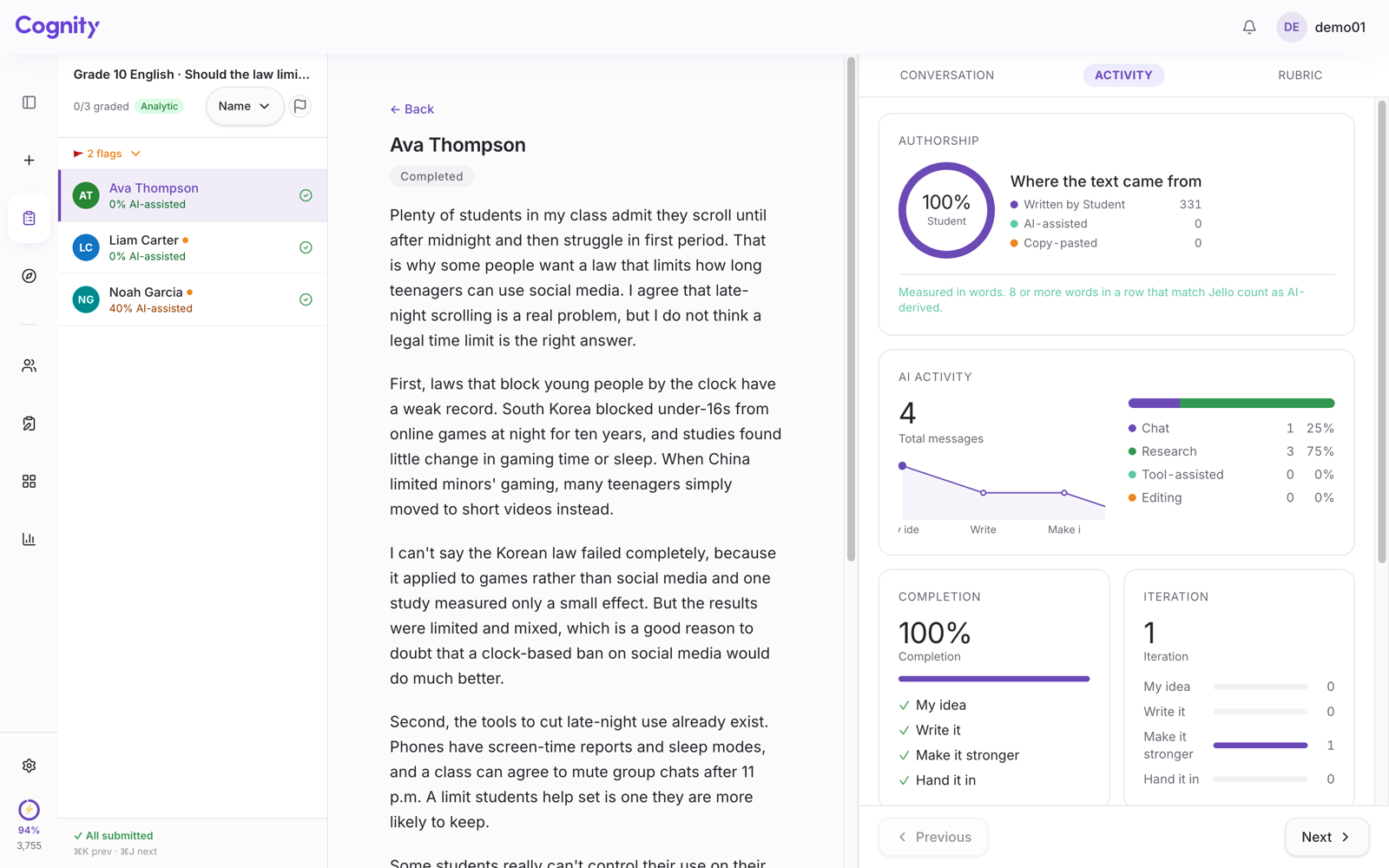
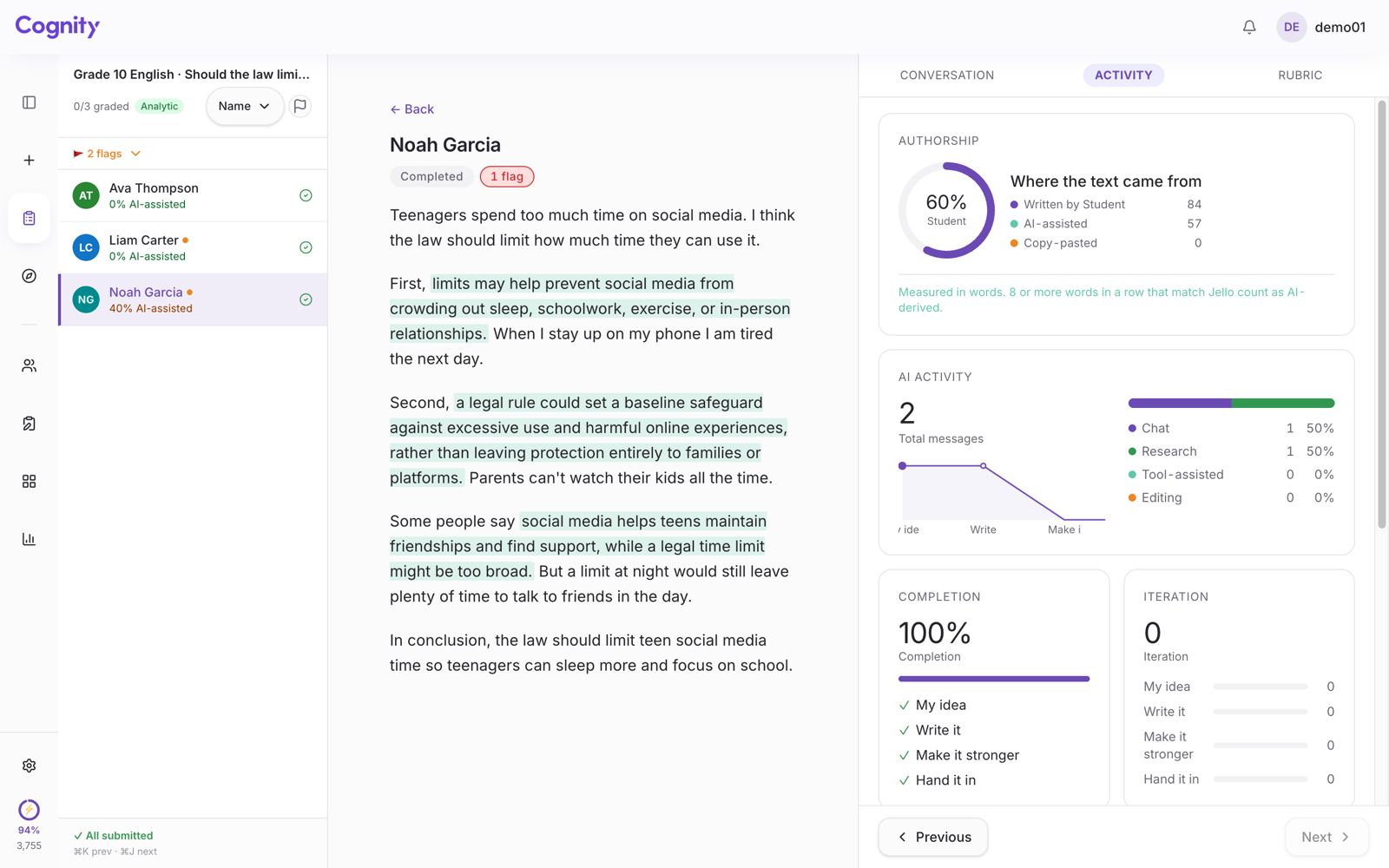
- A workspace where the AI is inside. If the AI assistant the student uses is part of the same environment where they write, the record is complete: every prompt, every response, every revision, in order.
This is what Cognity does. The teacher sets the task and the rules for what the AI may do, students join by link, and the teacher reads the process alongside the finished work.
The AI is also allowed to refuse: if a student asks it to write the essay, it declines and coaches instead, and that refusal is in the record too.
Why Cognity reads the process instead of giving a score is set out in AI detection alternatives.
How does a process record change the conversation with a student?
When the process is visible, the conversation with a student changes from "I think you cheated" to "I see you asked the AI for three arguments and then wrote your own. Tell me about the second one."
The student who did the work has proof. The student who didn't has a conversation about learning, not a tribunal.
That is the honest answer to how a teacher can tell. Usually you can't, from the text. So stop trying to, and look at the work instead.
If you want to see what a process record looks like with your own class, Cognity is free for individual teachers: 100 sparks a month, two active assignments, no credit card. Set a task in about a minute and read the first record when your students submit.
FAQ
Are AI detectors accurate enough to use on student work?
Not as evidence. OpenAI withdrew its own classifier in 2023 for low accuracy, and a 2023 study found that seven widely used detectors all misclassified essays by non-native English writers as AI-generated.¹²
Is it a problem if a student used AI at all?
Not necessarily. More than half of US teens have used AI chatbots for schoolwork, so what matters is how.⁴ Asking the AI to explain a source and pasting its essay are very different, and only a record of the process tells them apart.
If the record shows a paste, here is what to say to the student.
Sources
- OpenAI, New AI classifier for indicating AI-written text, 31 January 2023, with the update of 20 July 2023. Checked 29 September 2026.
- Liang, W. et al., GPT detectors are biased against non-native English writers, Patterns, 2023. Checked 29 September 2026.
- MIT Sloan Teaching & Learning Technologies, AI Detectors Don't Work. Here's What to Do Instead. Checked 29 September 2026.
- Pew Research Center, How Teens Use and View AI, 24 February 2026. Checked 29 September 2026.