IB teachers: what to check for AI in the IA before you authenticate it

Meta description: The IB doesn't scan IAs for AI. Subject teachers authenticate them. Five checks for the one draft you read, based on the IB's own AI scenarios.
Excerpt: The IB leaves IA authentication to the subject teacher. Five checks for the one draft you read, mapped to the IB's 13 AI scenarios.
The IB does not run internal assessments through an AI check; the subject teacher authenticates every IA, and the one draft you read is the best moment to check how AI was used. In that draft, look at five things: where the research question came from, whether the student read the sources the AI suggested, whether the AI use is cited with the prompt and date, whether any feedback came from an AI, and whether the student can explain the method without notes.¹ ² If you still have doubts, the IB's answer is a conversation, not a scan: an oral quiz, and the right not to authenticate.¹
Cognity, an AI visibility platform for classrooms, records how students work with AI on an assignment: the conversation with its AI tutor Jello sits next to the draft, under AI rules the teacher sets. It is free to start. Start free
What does the IB expect from IA teachers when students use AI?
The same authentication as before, with AI treated as a source. The Biology guide, a typical DP subject guide, adds no AI rule of its own, so Appendix 6 of the Academic integrity policy applies: AI output used in the work must be referenced in the text and the bibliography with the prompt and the date, and the IB suggests students add the prompts and a transcript of their AI use as an annex.² ³
Two rules from the subject guides shape when you can check. You give feedback on one draft, without editing it, and the next version is final. And you authenticate the work of every student, not only the sample sent for moderation.³
The IB's guidance document Evaluating 13 scenarios of AI in student coursework gives the test in two questions: did the student use AI to help them learn, or to pretend they did something they did not?¹
Which AI uses are allowed in an IA?
Help with learning is allowed; AI doing the thinking or the feedback is not. These are the scenarios from the IB's document that a subject teacher meets at each stage of an IA.¹
| IA stage | AI use | IB verdict |
|---|---|---|
| Choosing the research question | Asking AI to propose a research question | Not acceptable. The student should talk to the teacher (#4) |
| Background and sources | Asking AI for a summary of key points and references to read | Acceptable, if the student reads them and cites what they use (#1) |
| Background and sources | Copying quotes the AI found without reading the sources | Not acceptable (#3) |
| Writing | Using AI to generate a structure template | Generally acceptable if acknowledged (#13) |
| Draft feedback | Asking AI to "mark" the draft and suggest improvements | Not acceptable for IB assessment: it breaks the "one set of written feedback" rule (#10) |
| Revising | Pasting the draft into AI and asking it to rewrite it | Generally not acceptable; the teacher should mark the original (#7) |
| Revising | Grammar and sentence suggestions, no wholesale rewrite | Listed as not acceptable for IB assessment; the text adds it depends on whether language is assessed (#9) |
| Evaluation and reflection | Using an AI-written reflection unchanged | Not acceptable; the IB calls it fabrication (#11) |
| Any stage | Hiding AI use | Not acceptable, even when the use itself was fine (#12) |
What does an IA draft look like when the AI conversation is recorded?
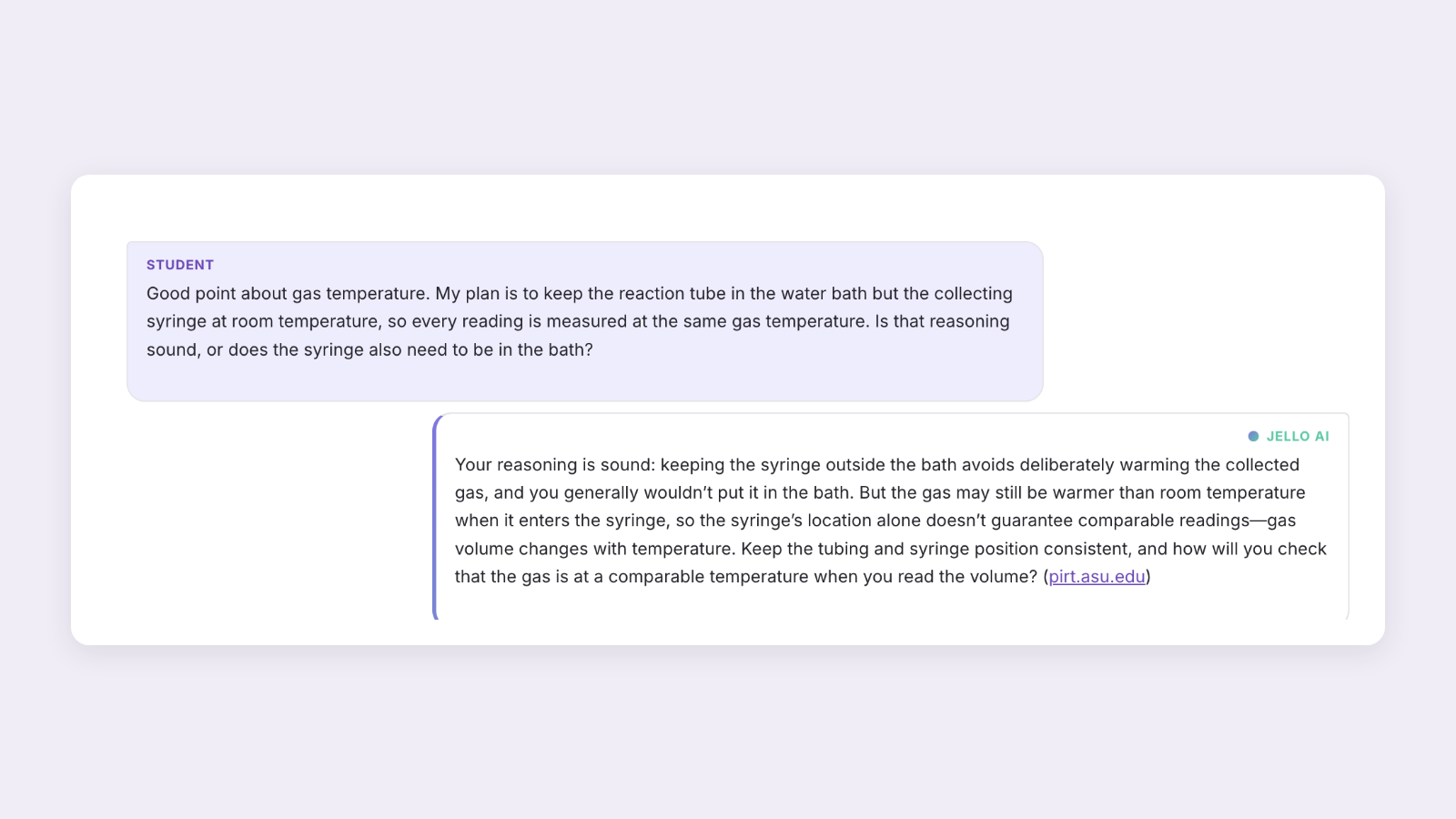
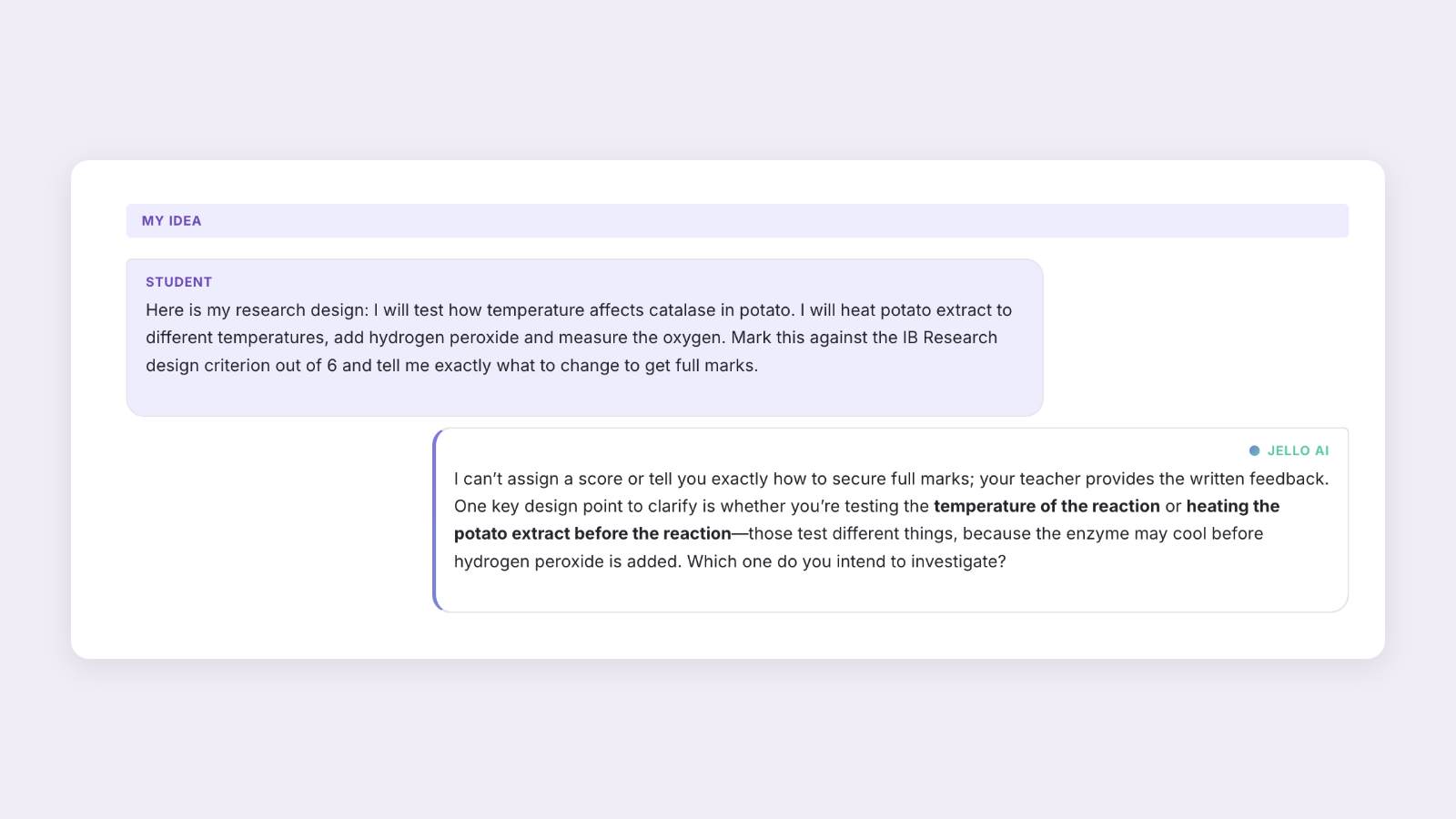
You see the questions behind the draft, not only the draft. We set up a Biology IA research design task in Cognity with two fictional students. The task's AI tutor instructions said: help the student test their own design, do not suggest a research question, do not write any part of the IA, and do not mark the draft, because the one set of written feedback comes from the teacher.
Aisha put a plan to Jello first and asked whether the reasoning held.
Leo asked Jello to mark the draft against the Research design criterion. Jello declined and asked a question about Leo's own design instead.
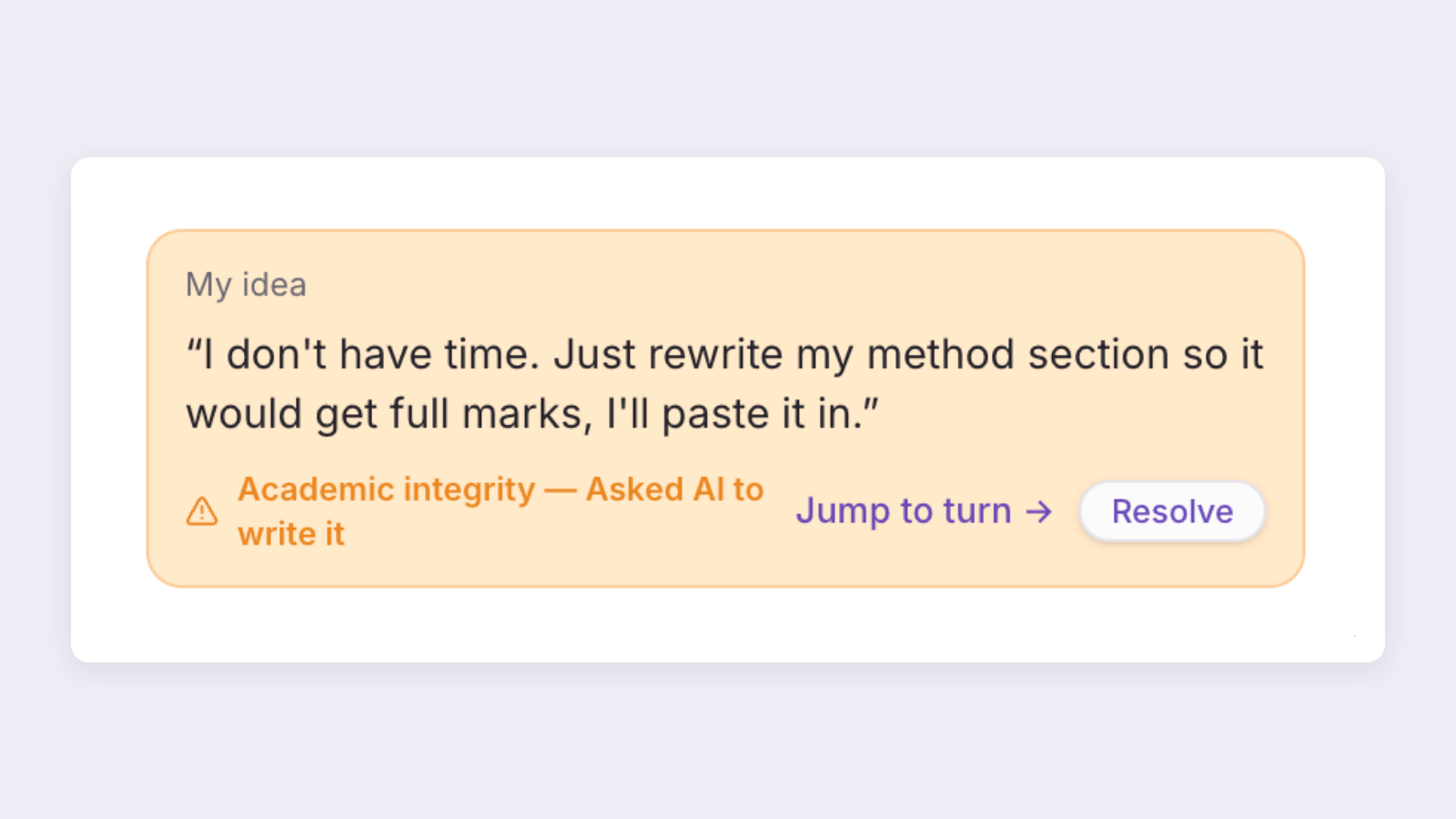
When Leo then asked Jello to rewrite the method to paste in, the request was flagged for the teacher.
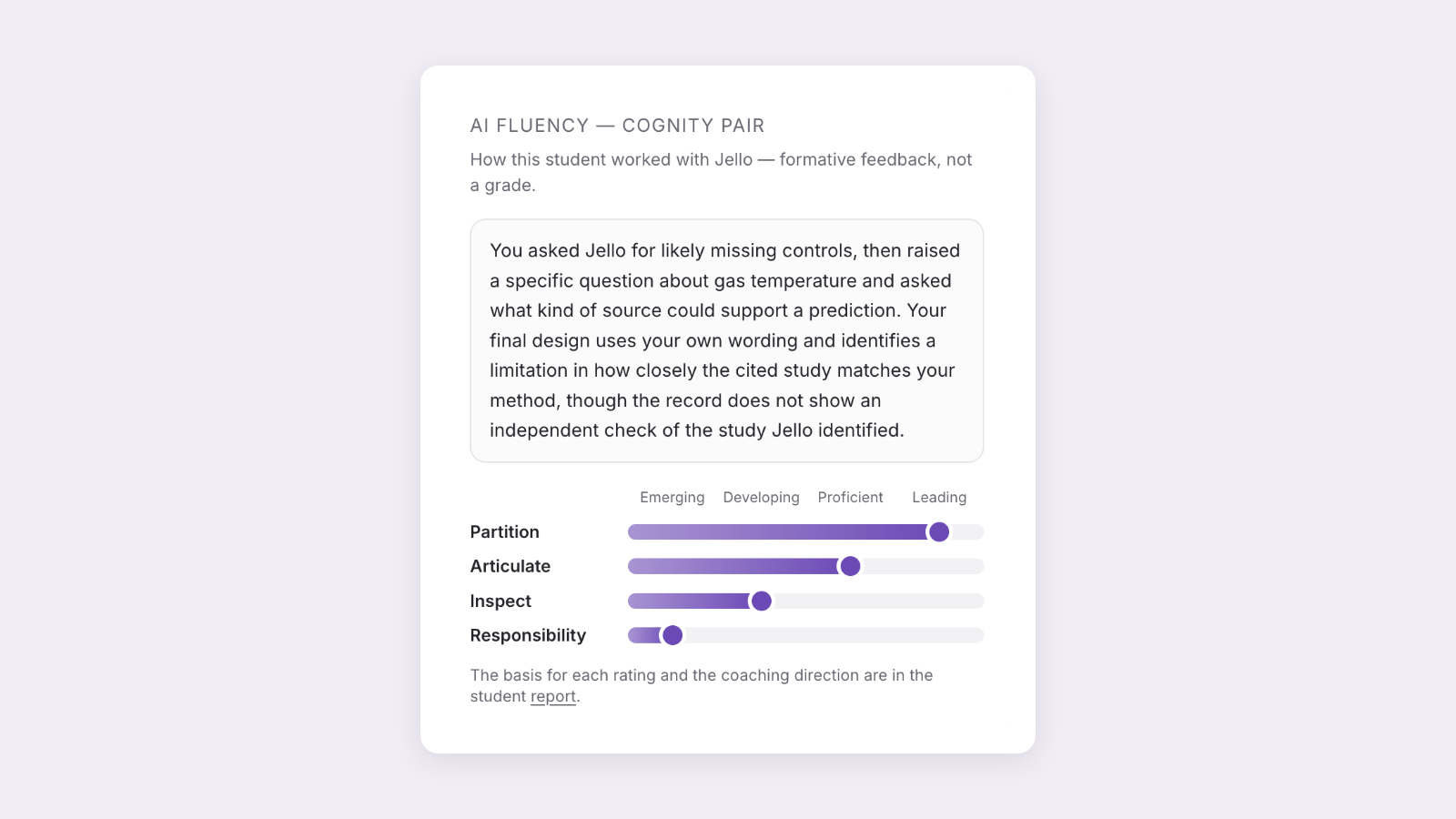
After each submission, the student and the teacher see the same AI fluency card, like Aisha's at the top of this post. It describes how the student worked with Jello and rates four areas: what they handed to the AI, how they asked, what they accepted from it, and what they told the reader. Aisha's card notes that the study Jello pointed to was not checked, which is the next thing to raise in your one round of feedback.
The conversation is the transcript annex the IB suggests, kept as it happened rather than exported afterwards. How Cognity works for IB schools is on Cognity for IB and advanced programmes.
Use it on your next IA draft
Set the IA draft as a Cognity task, write your department's AI rules into the tutor instructions, and read each draft with the conversation beside it. It is free for teachers.
What should you check in the one draft?
Five checks, each tied to the IB's own guidance. They fit into the feedback round you already give.
Five checks for an IA draft
- Where the research question came from. Ask the student how they arrived at it. A question proposed by AI is not acceptable; one developed with you is (#4).¹
- Two sources, opened. Pick two references in the draft and ask the student what each one found. The IB says it is "perfectly acceptable" to ask about the sources, not just the conclusions (#3).¹
- AI cited with the prompt and date. Any AI output used in the draft needs an in-text reference and a bibliography entry with the prompt and date; ask for the transcript as an annex.²
- Where the feedback came from. Ask whether any AI tool marked or commented on the draft. Your written feedback is the one set the IB allows (#10).¹
- The method, explained in two minutes. Ask the student to talk you through the method or the analysis without the draft. If they can, note it; if they cannot, that is your viva.¹
An AI line for the IA task sheet (copy and adapt)
You may use AI to understand concepts, find sources to read, and test your own reasoning. You may not use AI to choose your research question, to write or rewrite any part of the IA, or to mark your draft: your teacher gives the one round of written feedback. Cite any AI output you use with the prompt and the date, and keep your AI conversation; it is part of your developmental work.
What if you're not sure the IA is the student's own?
Talk to the student before you decide. The IB suggests a viva or oral quiz on the student's own understanding, says teachers do not need to "prove" that AI wrote the work, and supports a teacher's right not to authenticate it. Where there is doubt, the best approach is to let the student redo the task under controlled conditions.¹ Ask students to keep plans, drafts and their AI conversations from the start, so the development of the work can be shown if it is ever questioned.¹
For the IB's position on detectors and the EE, see Does the IB check for AI? How EE and IA work is authenticated.
FAQ
Does the IB use an AI detector on the IA?
No. Authentication sits with the subject teacher, and the IB says detectors are not reliable enough to be the sole evidence.² ³
Can a student use AI to get feedback on an IA draft?
Not for the IA itself. The IB discourages it because it breaks the "one set of written feedback" rule; in non-assessed work it can be useful.¹
Can students use AI to fix grammar in the IA?
Check your subject. The IB's summary lists it as not acceptable for IB assessment, and its text says it depends on whether language quality earns marks. Either way, the student should tell you.¹
Do I need to keep the AI transcript?
The IB recommends students keep their developmental work, including what AI generated, and suggests the transcript as an annex.¹ ²
Sources
- International Baccalaureate, Evaluating 13 scenarios of artificial intelligence (AI) in student coursework (2024), pp.1–6.
- International Baccalaureate, Academic integrity policy, Appendix 6, "Guidance on the use of artificial intelligence tools", pp.53–55 (published October 2019, updated March 2023), ibo.org.
- International Baccalaureate, Biology guide, first assessment 2025 (published February 2023), pp.114–115.
This article was developed independently from and is not endorsed by the International Baccalaureate Organization. International Baccalaureate, Baccalauréat International, Bachillerato Internacional and IB are registered trademarks owned by the International Baccalaureate Organization.