Take-home finals when students use AI: five formats compared
No take-home final is AI-proof, so choose a format that makes AI use part of the work and keeps the student's reasoning visible. A critique of an AI-written answer, or a final paper written where the process is recorded, shows the most. A generic open-book exam shows the least: in a blind test, 94% of AI-written answers went unnoticed.¹
Cognity, an AI visibility platform for classrooms, records how students work with AI inside an assignment. This post follows Are AI detectors accurate? What universities decided: if a score cannot tell you who used AI, the format of the final has to show you what they understood.
Below, five take-home formats are compared, with an AI block you can paste into your instructions.
Can you still set a take-home final when students use AI?
Yes, but not one that assumes they won't use it. At a UK university, researchers submitted answers written entirely by AI to unsupervised take-home exams in five undergraduate psychology courses. Graders did not notice 94% of them, and the AI answers scored higher on average than real students' answers.¹
A ban does not change that. The University of Alberta's teaching centre concludes that "there is no guaranteed AI-free take-home assessment",² and the University of Sydney goes further: "Any unenforceable restriction such as stating that AI is not allowed damages assessment validity and is untenable."³
Your students are already in this position. In a survey of 1,054 UK undergraduates, 94% said they use generative AI to help with assessed work.⁴ The useful question for the final is not whether they will use it, but what the format lets you see when they do.
What does each take-home format show you?
The five formats below run from the one AI changes most to the one where AI use is most visible. "Grading load" is per student, before any follow-up.
| Format | What AI does to it | What it shows you about understanding | Grading load |
|---|---|---|---|
| 1. Open-book exam, general questions | Can answer most questions in full¹ | The final answer only | One read |
| 2. Questions anchored in your course | Still helps, once the student supplies the course material | How the student applies course ideas, in the answer | One read; new questions each year |
| 3. Critique of an AI-written answer | AI use is the task itself | Whether the student can find errors and gaps in the subject | One read; you prepare and check the AI answer |
| 4. Final paper with an AI-use statement | Allowed and reported by the student | What the student chooses to report | The paper plus the statement or chat log |
| 5. Final paper written where the process is recorded | Allowed and recorded where the work happens | How the argument was built, checked and revised | A summary first; the full record where needed |
1. Open-book exam with general questions
What it is: the traditional take-home. Students get essay or problem questions that any textbook covers, work at home, and submit their answers.
What you see: only the final answers. This is the format the blind study tested, and the one AI handles best: most AI-written answers went unnoticed.¹
When to keep it: only if its weight is low. The University of Alberta suggests asking yourself whether you are comfortable "giving 30% of students' grades to AI", and lowering the weight if not.²
2. Questions anchored in your course
What it is: the questions only make sense with material from your course, such as the case you discussed in week 9, the class dataset, or the feedback the student got on their own midterm. Pitt's teaching centre recommends tasks "that demand personal interpretation and engagement with complex, layered situations".⁵
What you see: how the student applies course ideas to that material. AI can still help, but only once the student brings the course to it, and the answer shows whether they can.
The cost: you write new questions each year, because last year's case and dataset are no longer only yours.
3. Critique of an AI-written answer
What it is: you put one of your exam questions to an AI tool yourself and give every student the same AI answer. The student's task is to grade it: find "errors, gaps, or unsupported claims"⁵ and say what a correct answer would add. In an economics course, for example, the AI answer might apply a model correctly but ignore the assumption your course spent a week on. Teaching centres recommend this format as a way to make AI use part of the task; Florida International University describes a version where students critique an AI response for "accuracy, bias, and limitations".⁸
What you see: whether the student knows the subject well enough to spot a plausible mistake. Students can ask AI to critique the answer too, but finding the error that matters in your field still takes knowing the field.
The cost: before handing it out, check the AI answer yourself and choose one whose errors matter for your course.
4. Final paper with an AI-use statement
What it is: students write the paper with AI allowed, then attach a short statement or a copy of their chat history. Pitt suggests asking "how AI assisted their work, where they chose not to use it and why".⁵ The UK's Quality Assurance Agency calls fully acknowledged AI use "a useful transitional arrangement".⁶
What you see: the paper, plus what the student decides to report about how it was made.
The limit: both the statement and the chat log are what the student chooses to hand in. A conversation in another tab does not have to appear in either.
5. Final paper written where the process is recorded
What it is: students write the paper in one place that keeps its history, so the process arrives with the result. They do not submit drafts separately; the record builds up as they write. Australia's higher-education regulator, TEQSA, suggests requiring "a verifiable version history" or a writing platform that records "when content is pasted".⁷
What you see: how the argument was built, checked and revised, and where pasted text came in. TEQSA notes this also lets you give feedback on the process, "not just feedback on the final product".⁷
What it looks like: in Cognity, students write the final inside the assignment, with its AI tutor Jello, and the record builds up as they work. The Activity tab's authorship card, "Where the text came from", splits the paper into Written by Student, AI-assisted and Copy-pasted. It counts words, and 8 or more words in a row that match Jello count as AI-derived, so the figure points at sentences you can read.
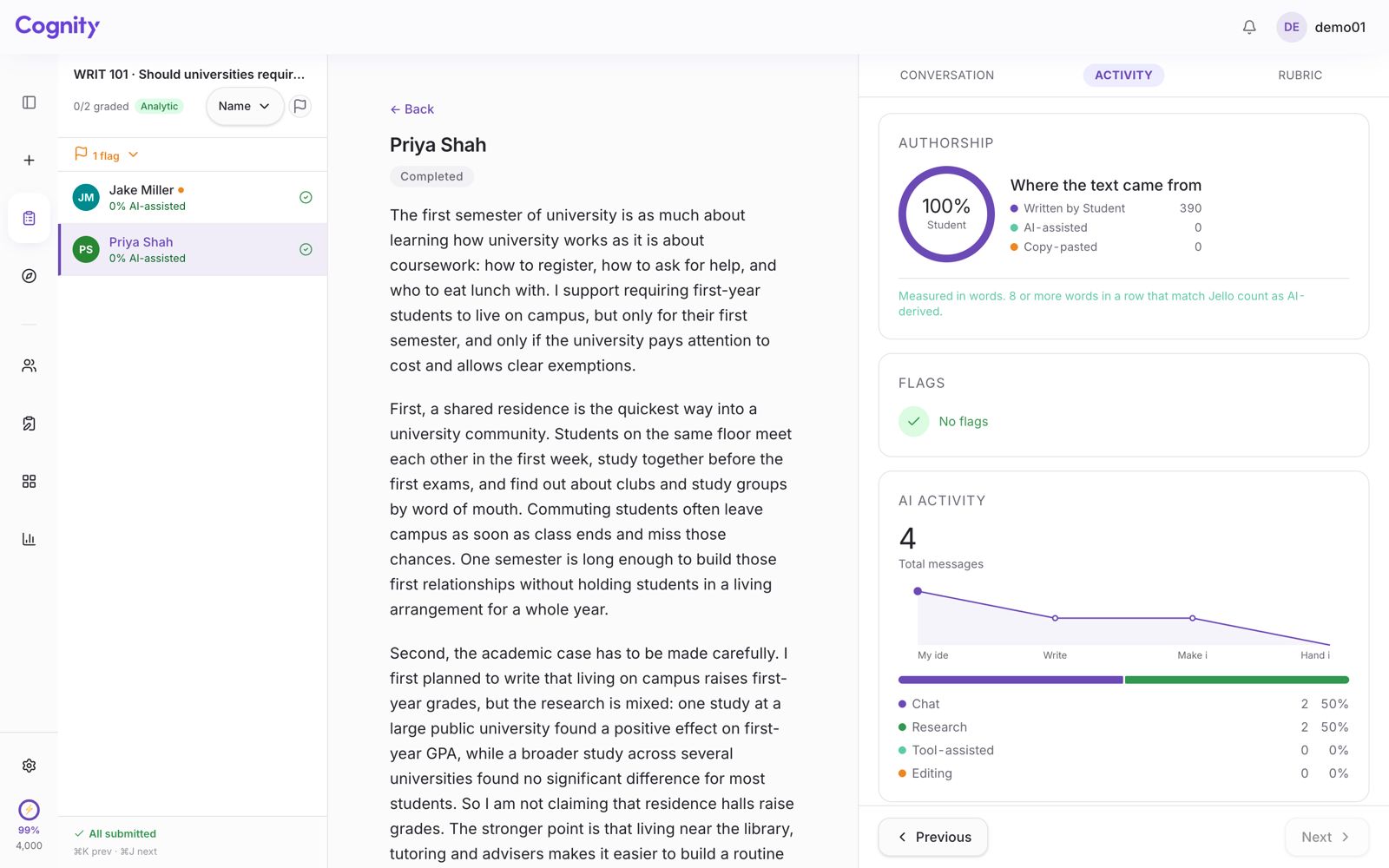
The cost: students have to write in that tool rather than wherever they like, so say so when you announce the final.
Which take-home format fits your course?
If AI is allowed on the final, make format 5 the base and add the others to it: the question format decides what students must do, and the recorded process shows how they did it. The one case it does not cover is knowledge students must show without AI.
- Knowledge that must be shown without AI. Do not make it a take-home. Supervise that part in person, as Sydney's "secured" lane does,³ and keep it short.
- Writing and argument. Use format 5, and ask for the short statement from format 4 at the end. The statement tells you what the student thinks they did; the record shows what happened.
- Applying the course to new problems, including large courses. Set a course-anchored question (format 2) and have students write the answer where the process is recorded (format 5). In a large course, read the activity summary for every student and open the full record only where the summary or the answer raises a question.
- Judging AI output. Set the critique (format 3) and run it in format 5 as well, so you see how each student checked the AI answer, not only what they concluded.
- Format 1 on its own. Only if the weight is low enough that you would accept AI doing the work.²
For an essay assignment during term rather than the final, the comparison in How should university essay assignments change for ChatGPT? covers drafts submitted in stages, oral checks and in-class writing.
What should the final's instructions say about AI?
Say what AI may be used for, what is graded, and what students submit with the paper. The University of Alberta's teaching centre puts it plainly: when AI is allowed, asking students "to describe how it was used in completing this particular take-home is a good idea".² Adapt this block to your final:
AI on this take-home final
- You may use AI to: explain concepts, test your argument, find counter-arguments, and check your reasoning.
- The task asks you to: apply [the course case / dataset / your midterm feedback], which AI does not have unless you give it.
- What is graded: your analysis and judgement — where you agree or disagree with sources and with AI, and why.
- Submit with your final: a short note on what you asked AI, what you kept, and what you rejected.
- Not allowed: submitting AI-written sentences as your own wording without saying so.
- If you are unsure whether a use is allowed, ask before the deadline.
For wording the rule in other assignments, see how to write AI rules for one assignment.
The note at the end is still the student's account. It shows what they remember and choose to report, not the conversation that shaped the paper, because that conversation usually happened in another tab. To read the process itself, the AI and the writing have to be in the same place.
How can you read the process behind a final paper?
Keep the AI conversation and the writing in one assignment, so the process is recorded as the student works. In Cognity, students write inside the assignment with its AI tutor, Jello, following the AI rules you set. When you open a submission, the paper sits next to the conversation with Jello and an activity record of how the paper was written, stage by stage, from first idea to submission.
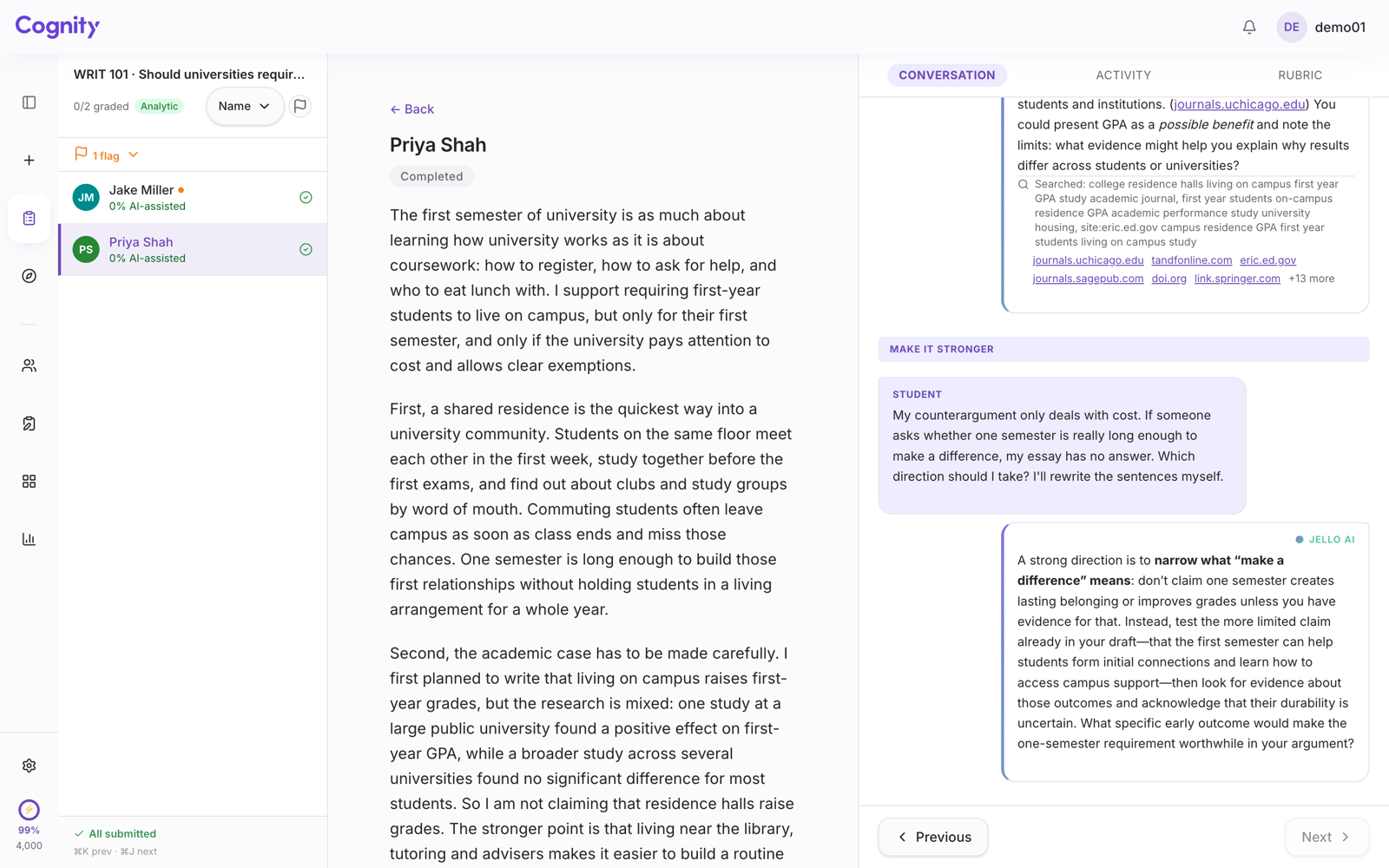
Read the conversation next to the Activity tab shown in format 5, and you can see which question led to which change in the paper.
Cognity does not give an AI score and does not detect AI. It shows the process, and the judgement on the paper stays with you. To see how this runs across a whole course, from AI settings per assignment to LMS launch, see Cognity for universities.
Cognity is free to start. Try it on your next assignment.
FAQ
Can I ban AI on a take-home final?
You can write the ban, but you cannot enforce it outside a supervised room, and Sydney argues an unenforceable ban "damages assessment validity".³ If a part of the final must be done without AI, supervise that part and keep the take-home for work where AI use is allowed and visible.
Should I lower the weight of the take-home final?
If it is format 1, probably. The University of Alberta's test is whether you are comfortable "giving 30% of students' grades to AI".² Formats 3 and 5 hold more weight, because what they grade is the student's own judgement.
Is a chat log enough to see how a student used AI?
It shows the conversations the student chose to submit. Pitt notes that the quality of a student's prompts "assesses conceptual depth directly",⁵ which makes the log worth reading. A log recorded where the work happens is more complete than one the student exports and attaches.
Will an AI detector catch AI-written answers on a take-home final?
Not reliably enough to grade on. In the blind study, graders missed 94% of AI-written answers,¹ and detectors bring their own error rates, set out in Are AI detectors accurate?. A format where AI use is part of the task gives you something to grade instead of something to suspect.
References
- Scarfe, P., Watcham, K., Clarke, A. & Roesch, E. (2024), "A real-world test of artificial intelligence infiltration of a university examinations system: A 'Turing Test' case study", PLOS ONE 19(6): e0305354, 26 June 2024.
- University of Alberta Centre for Teaching and Learning, "Take-home exams, AI, and the Question beneath the Question", 23 February 2026.
- The University of Sydney, "Frequently asked questions about the two-lane approach to assessment in the age of AI", updated 21 April 2026, checked 19 October 2026.
- HEPI, "Student Generative AI Survey 2026", 1,054 full-time UK undergraduates, December 2025.
- University of Pittsburgh Teaching Center, "AI's effect on finals and end-of-term assessments", updated 15 September 2026.
- QAA, "Reconsidering assessment for the ChatGPT era: QAA advice on developing sustainable assessment strategies", July 2023, p. 4.
- TEQSA, "Detecting plagiarism and AI-generated text in student assessments and securing take-home written assessments", updated 8 May 2026.
- Florida International University Center for the Advancement of Teaching, "Design Strategies for Assessing Learning with AI", checked 19 October 2026.