How should university essay assignments change for ChatGPT?
University essay assignments are shifting from grading the finished text to grading how it was produced. University guidance points the same way: redesign the assessment rather than police AI use, and several universities have switched their AI detectors off. Which redesign fits depends on your class size and how much grading time you have.
Cognity is an AI visibility platform for classrooms: students work with AI inside it, and the instructor sees how. This post compares the approaches universities recommend and what each one actually lets you see.
How many students already use AI on assessed work?
Almost all of them. In a December 2025 survey of 1,054 full-time UK undergraduates, 94% said they use generative AI for assessed work.¹
Institutions are moving more slowly. A 2025 UNESCO survey of higher education institutions in 90 countries found that 19% had a formal AI policy and 42% were still writing one.² In practice, the rule for a given assignment is usually set by the instructor who wrote it.
What do university guidelines recommend?
Published guidance converges on three things: tell students the AI rules for each task in advance, assess the process rather than only the product, and keep some assessment supervised.
- The University of Sydney's "two-lane" approach. Lane 1 is secure, supervised assessment. Lane 2 is open assessment where AI use is scaffolded and supported, and from Semester 1 2025 AI is allowed in unsupervised assessments unless expressly prohibited.³ Sydney's reasoning is that an unenforceable ban damages assessment validity.
- Australia's higher education regulator, TEQSA, published assessment reform principles in November 2023 to help institutions review the integrity of their assessment and build generative AI into it.⁴
- Detectors are not part of these frameworks. Vanderbilt University disabled Turnitin's AI detector in August 2023. At its volume of 75,000 papers a year, a 1% false-positive rate would mean around 750 students wrongly flagged.⁵
The false positives are not spread evenly either. In a 2023 study in Patterns, seven commercial detectors all misclassified essays by non-native English writers as AI-generated, while classifying native speakers' essays correctly.⁶
Five ways to run an essay assignment: what does each let you see?
Staged drafts, oral checks, in-class writing, attached AI chat logs and process-recording tools each show you something different, at a different cost in your time. Here they are side by side for a class of 100.
| Approach | What you can see | Your time, 100 students | Limit |
|---|---|---|---|
| Staged submission (outline → draft → final) | Each intermediate draft | Roughly three rounds of grading instead of one | What happened between drafts stays invisible |
| Oral check | The student's understanding, directly | At 10 minutes each, close to 17 hours | Not realistic for every student in a large course |
| In-class writing | Text written without AI | Class time given over to writing | Says nothing about how well students use AI |
| Attached AI chat logs | The conversations the student chose to submit | More to read per submission | Students can select or edit what they show |
| Process-recording tool | The whole writing process | Read a summary first, open the full record when needed | Only records work done inside the tool |
Oral checks are the most direct test of understanding, so in a large course they work best on a sample of students or on submissions that raise questions.
In-class writing removes AI from the task, which also removes the skill most graduates will be expected to have: using AI well.
Attached chat logs are the easiest to start with, since there is nothing to set up. But a log the student selects is a curated account, not the process.
Staged submission and a process-recording tool combine well: you collect drafts at each stage and read the record of what happened in between.
What can you grade once you can see the process?
You can grade how a student used AI rather than whether they did. For example:
- Does the prompt show the student understood the problem? A student who can state the task precisely has already done the hard part.
- Did they notice when the AI was wrong? Rejecting a plausible wrong answer takes knowledge of the subject.
- Did they check a claim or take it as given? You can see whether a source was verified before it went into the draft.
- Whose thinking drove the argument? The record shows where the student set the direction and where they followed the AI.
None of these can be delegated to the AI, which is why they separate students more clearly than the finished text does.
What does the process look like in Cognity?
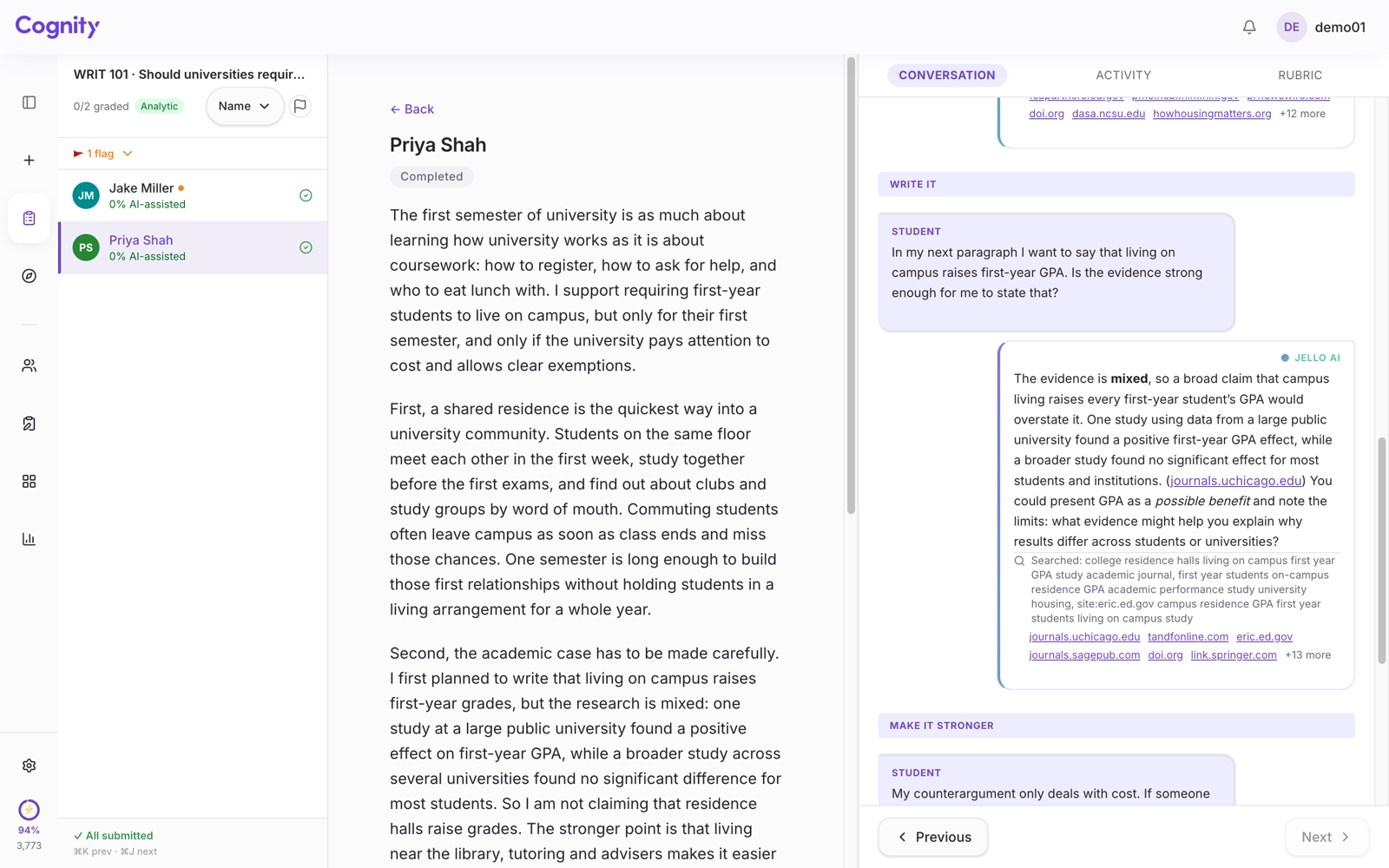
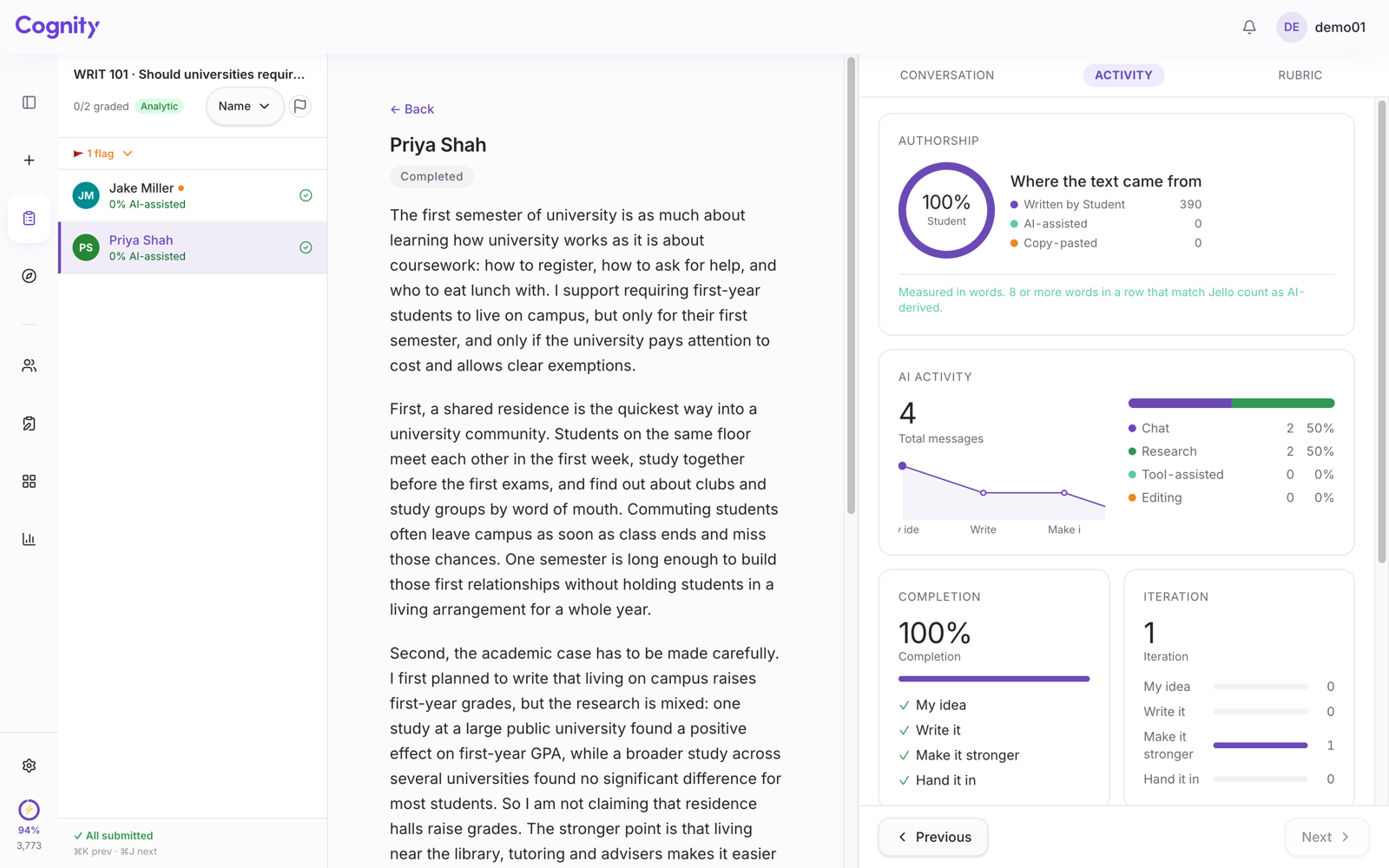
Students write inside Cognity with its AI tutor, Jello, instead of in a separate chatbot. When you open a submission, the finished essay sits next to two tabs: the conversation between the student and Jello, and an activity record of how the essay was written.
The Conversation tab keeps every exchange, labelled by stage. The student below checked a claim with Jello halfway through writing, then narrowed it in her essay.
The Activity tab splits the essay's words into Written by Student, AI-assisted and Copy-pasted, and shows how many AI messages and revisions happened at each stage: My idea, Write it, Make it stronger, Hand it in.
A submission pasted in from elsewhere looks different in the same assignment.
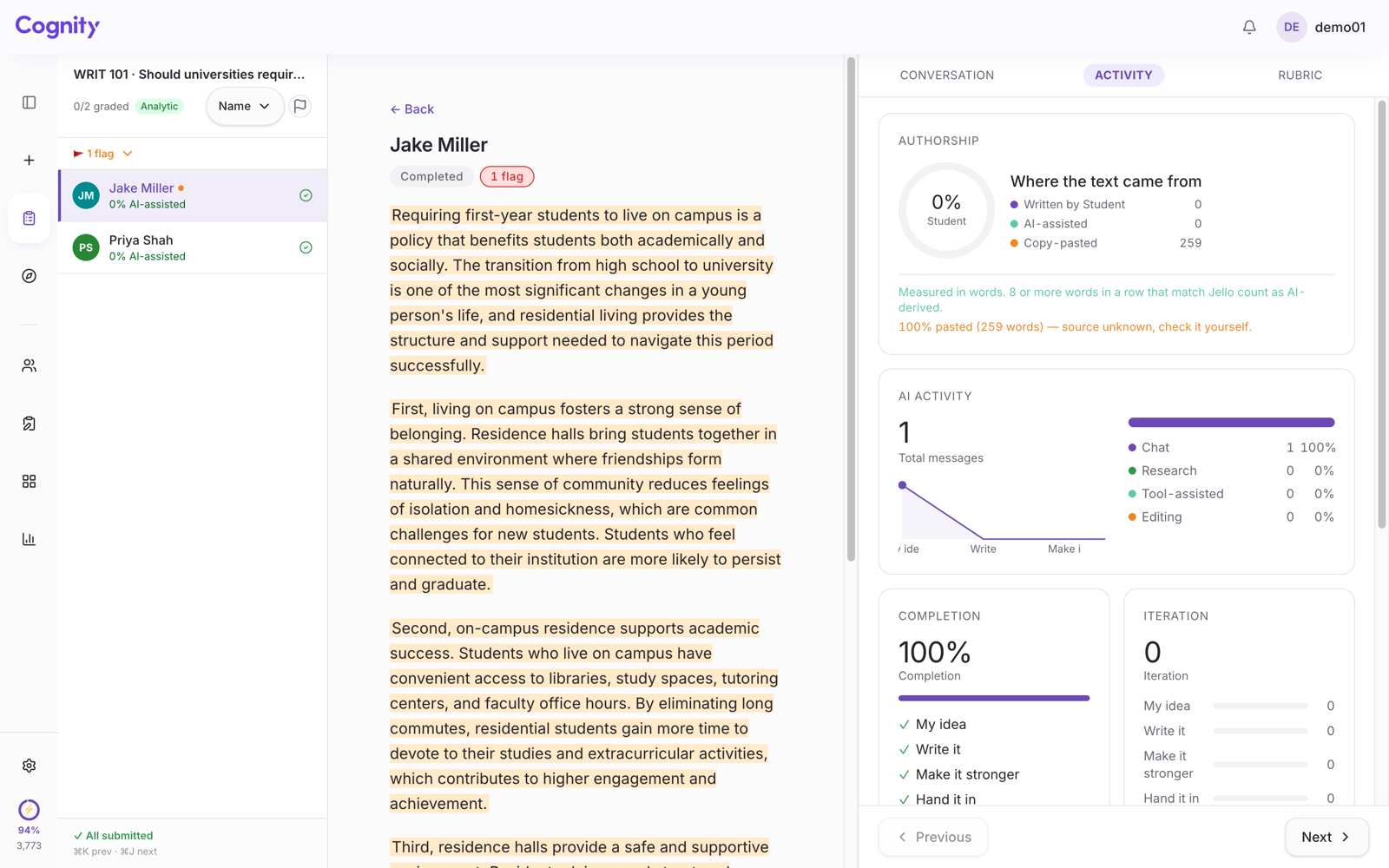
Cognity shows the process; it does not issue a verdict. Pasted text is marked as coming from an unknown source, not as AI, and the judgement stays with you.
Students join from a link, with no sign-up. For a department-wide rollout, Cognity also connects to your LMS.
To see how Cognity works in university courses, look at Cognity for universities.
How should you write the AI rule into your syllabus?
Split it into what students may use AI for, what they must disclose, and what is off limits, and repeat it in the assignment instructions. Adapt this to the task:
Generative AI on this assignment
- You may use AI to: research the topic, plan an outline, ask for an explanation of a concept.
- You must disclose: any source or idea suggested by AI that you use. List the tool and what you used it for at the end of the essay.
- You may not use AI to: write or rewrite sentences that appear in your essay.
- If you are unsure whether a use is allowed, ask before you submit.
Cognity is free to start. Why not run next week's essay assignment in it?
FAQ
Can I use an AI detector score as evidence?
It is not a safe basis for a grade. A score is a probability the student cannot answer and you cannot verify, and detectors misclassify non-native English writers far more often.⁶ Treat it at most as a prompt to look at the process.
Doesn't allowing AI make the essay too easy?
Only if you grade the finished text alone. Once the process is part of the grade, the marks go to what AI cannot do for the student: noticing when it was wrong, and deciding where the argument goes.
The higher education page shows how this runs across a whole course. The case against detectors in full is in How can a teacher tell if a student used ChatGPT?, and the comparison with Turnitin's process view is in Cognity vs Turnitin Clarity.
Sources
- HEPI, Student Generative AI Survey 2026. 1,054 full-time UK undergraduates, December 2025.
- UNESCO, Two-thirds of higher education institutions have or are developing guidance on AI use, September 2025. 400 institutions in 90 countries.
- The University of Sydney, Frequently asked questions about the two-lane approach to assessment in the age of AI. Checked 29 September 2026.
- TEQSA, Assessment reform for the age of artificial intelligence, November 2023.
- Vanderbilt University, Guidance on AI detection and why we're disabling Turnitin's AI detector, 16 August 2023.
- Liang, W. et al., GPT detectors are biased against non-native English writers, Patterns, 2023.