What is a process portfolio, and how do you assess one?
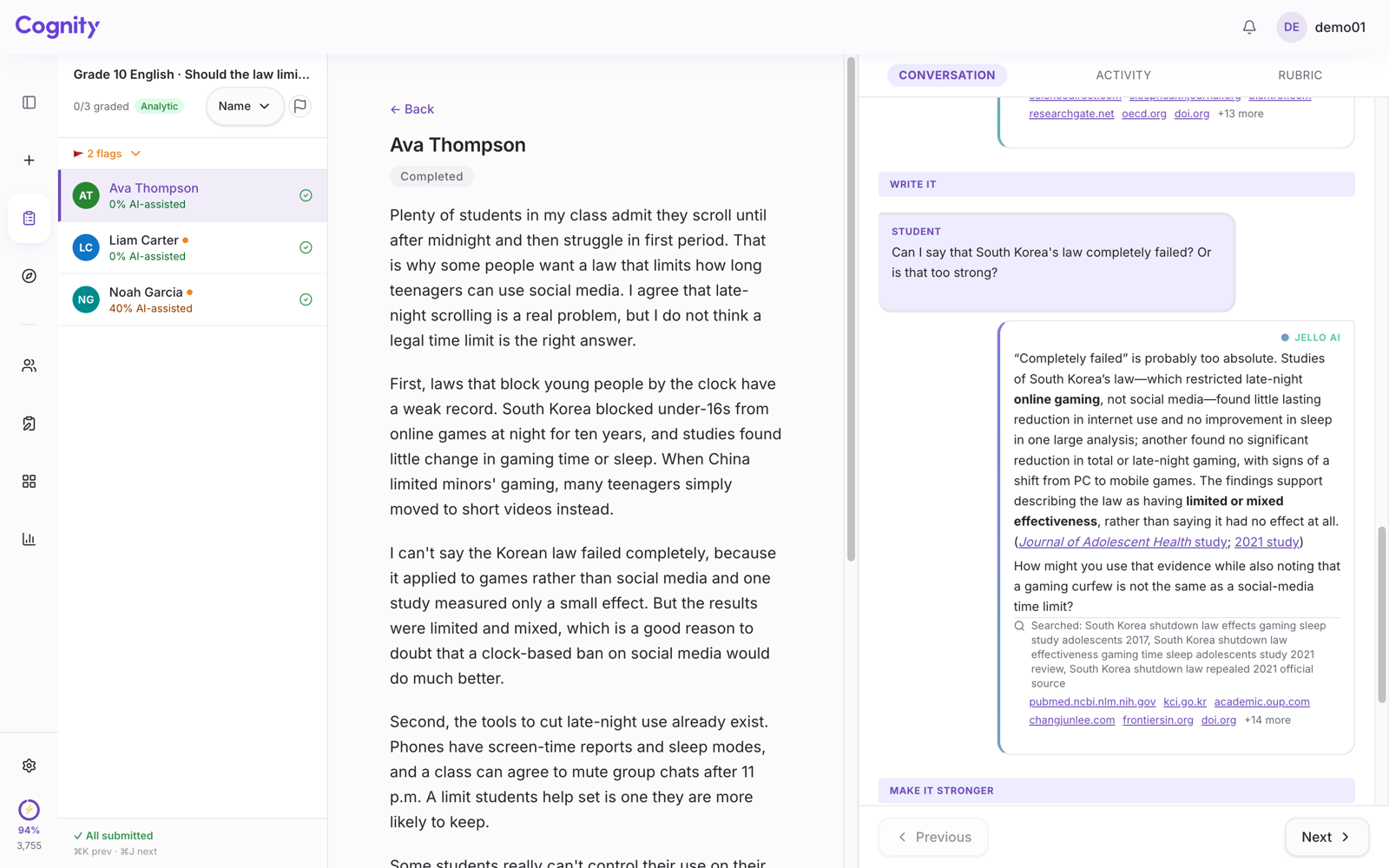
A process portfolio is the record of how a piece of work came to be: the drafts in order, the sources and AI conversations the student used, and their own account of each decision, kept beside the finished text. When AI can produce a fluent essay on demand, that record, not the essay, shows what a student can do.
For most of the history of schooling, the finished piece of writing was a reasonable proxy for the thinking behind it. If a student handed in a good essay, they had probably done the reading, formed the argument, and struggled with the sentences. The text was evidence of the work.
That proxy has broken. A fluent, well-structured, on-topic essay can now be produced in less time than it takes to read, by a student who has done none of those things. The essay is no longer evidence of anything except access to a chatbot.
This is the actual problem with AI in schools, and it is why detectors were always the wrong answer: they try to rescue the proxy instead of replacing it.
What goes in a process portfolio?
At minimum, a process portfolio keeps these alongside the finished piece:
- The drafts, in order
- What changed between drafts, and why
- The sources and tools the student consulted
- The AI conversation, if AI was used: what the student asked, what they were given, what they kept and what they rejected
- The student's own account of their decisions
The finished essay is still there. It is just no longer the whole submission.
To see how Cognity works across a school, look at Cognity for Schools.
Why is a process record better evidence than the essay?
A finished text tells you what the student ended up with. A process record tells you what they could do. A student who asks the AI for three counterarguments and then writes a fourth of their own has shown you something an essay cannot show.
A student who asks the AI to explain a source, then rejects its summary because it missed the author's point, has shown you reading comprehension in the act. A student whose draft barely changes from the AI's first response has shown you that too.
None of that is visible in the text. All of it is visible in the record. For assessment, that is not a compromise; it is an upgrade.
How does grading change with a process portfolio?
The rubric shifts. Criteria like "quality of argument" remain, but they are now read against the process: whose argument, arrived at how.
New criteria also become possible. They are the skills students will actually need, and they were never assessable from a finished text. Criteria you can add to a rubric:
- How well the student directed the AI
- Whether they verified what it gave them
- Whether they recognized when it was wrong
The conversation shifts. Feedback moves from "this paragraph is weak" to "I see you asked for feedback here and got a generic answer; try asking about the one claim you are least sure of." That is coaching the process, which is where learning happens.
The integrity question mostly disappears. Not because students stop misusing AI, but because misuse is visible without accusation.
A submission whose record shows a single paste and no drafting is not a mystery. It is a conversation that starts with the record.
What does a school gain from process portfolios?
For a school leader, the portfolio is also the answer to the question parents and accreditors are starting to ask: how do you know students are learning when they all have AI?
"We ban it" is not an answer anyone believes. "We detect it" is an answer that fails the first time a detector misfires on a bilingual student: in one study, all seven detectors tested misclassified essays by non-native English writers as AI-generated.¹ "We can show you the process" is an answer.
It also solves a data problem. A school that keeps process records learns, in aggregate, how its students actually use AI: what they ask, where they get stuck, which tasks invite shortcuts and which invite thinking. That is curriculum information no school has ever had.
For IB schools turning this into policy, see Cognity for IB and advanced schools and the IB AI policy checklist for coordinators. For courses at university level, see Cognity for universities.
Isn't a process portfolio more to read?
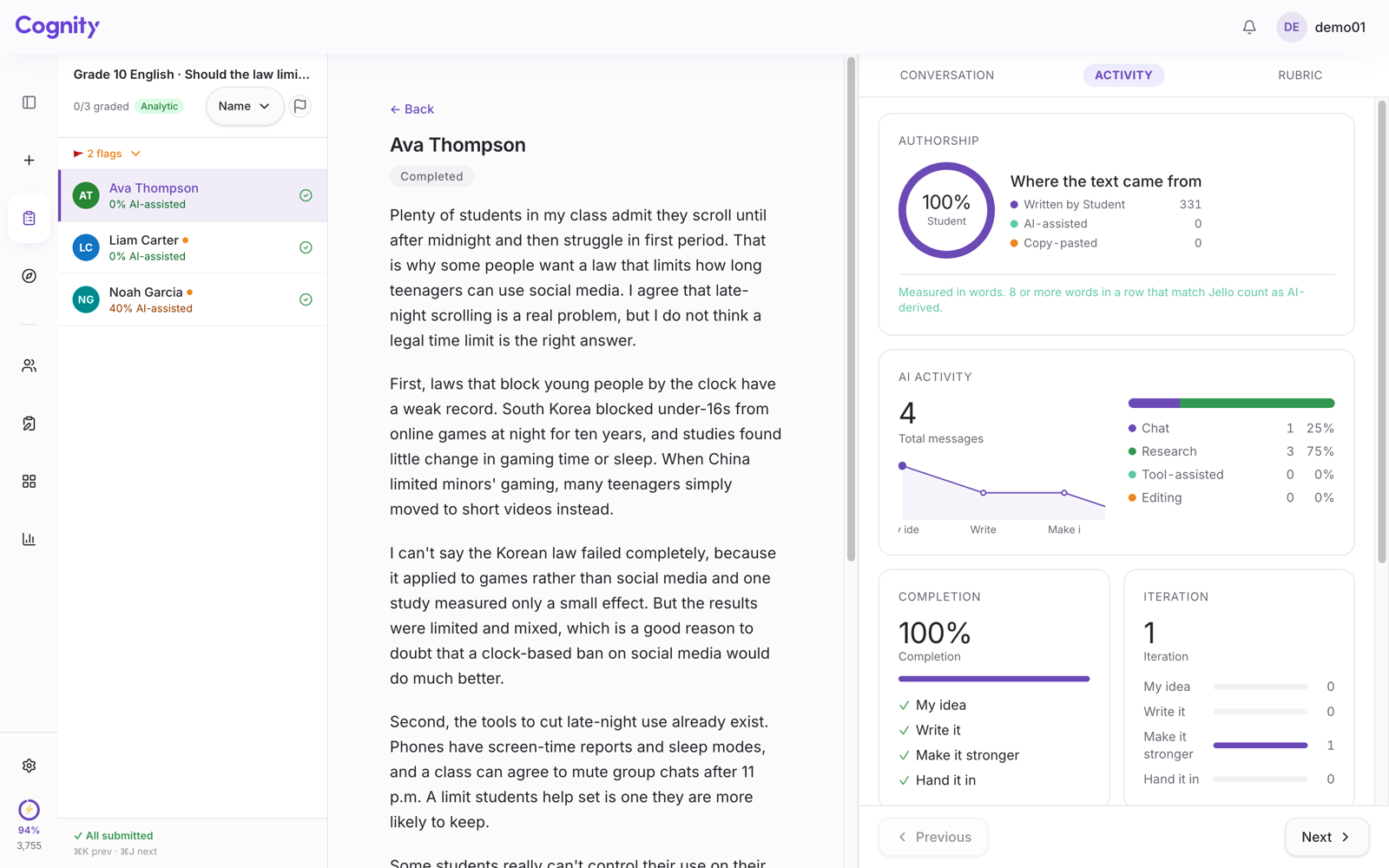
The objection is always the same: this is more to read. It is, if the record is a pile of screenshots. It is not, if the record is structured: a timeline the teacher can skim, the Authorship panel at a glance, the AI conversation collapsed until it is needed.
The design goal is that reading the process takes about as long as reading the essay used to, and tells the teacher more.
That is what Cognity, a classroom AI workspace, is built to be. Students work with an AI assistant inside a workspace where the teacher set the task and the rules; every prompt, response and revision is recorded; and each submission arrives with the finished text, the process timeline, and the Authorship panel together.
The portfolio is not extra work. It is the submission.
If you want to see what one looks like, Cognity is free for individual teachers. Set a task, share the link, and read the first portfolio when it comes in.
FAQ
Is a process portfolio the same as version history?
No. Version history shows how a document changed. A process portfolio also holds the student's AI conversation and their own account of their decisions, which is where their thinking shows.
Does a process portfolio replace the essay?
No. The finished essay is still submitted. It is just no longer the whole submission: it is read alongside the record of how it was made.
Why a detector score can't do this job: How can a teacher tell if a student used ChatGPT?
Sources
- Liang, W. et al., GPT detectors are biased against non-native English writers, Patterns, 2023. Checked 29 September 2026.