IB AI policy checklist: 9 questions for coordinators
An IB-aligned AI policy has to do one thing the IB requires, which is make students credit AI-generated work in the text and the bibliography, and several things the IB leaves to schools: set AI rules per assignment, say how a teacher checks an acknowledgement, and rule out detector scores as evidence. The nine questions below test for each.
The IB's academic integrity policy now includes an appendix on the use of AI tools.² The core requirement is that AI-generated work included in a piece of assessment must be credited in the body of the text and appropriately referenced in the bibliography.¹ The IB also says it will continue to rely on human examiners to mark its assessments, and that students should be taught to understand the bias in what AI tools produce and to review it critically.¹
The IB's standard is clear for the finished work, and says much less about how a school gets there. Most coordinators we speak with have a policy document; fewer have a policy that a Grade 11 teacher can apply on a Tuesday.
This checklist is for the gap between the two. It is not legal advice and it is not an IB document. It is what a coordinator can check before the policy goes out.
The nine checks, in a form you can paste into a policy draft:
- AI use is allowed; uncredited AI content in assessed work is the misconduct.
- The acknowledgement format is specified, with a template.
- Each assessed task states what AI may and may not do.
- The policy names how a teacher checks an acknowledgement.
- Detector scores are ruled out as evidence.
- A suspected case starts with a conversation.
- Task-level rules appear on the task itself.
- Someone owns unanticipated cases, and decisions are added as examples.
- The policy is reviewed one term after launch.
1. Does the policy distinguish between AI use and AI misconduct?
The IB requirement is about crediting AI-generated content, not about banning AI; its own policy says it will not ban the use of AI software.² A policy that reads as a ban will be ignored by students and impossible for teachers to apply.
State plainly that AI may be used, and that uncredited AI-generated content in assessed work is the misconduct.
2. Is the acknowledgement format specified?
"Must be credited" needs a form. Decide what the in-text credit looks like (a bracketed note, a footnote) and what the bibliography entry contains: tool, version or date, and the prompt or a summary of it.
The IB's guidance asks for AI-generated text to be in quotation marks, in the referencing style the school already uses, with the prompt and the date the text was generated in the citation.² Give students a template.
A copyable one is in An AI acknowledgement template for IB and international schools.
3. Are rules set at the assignment level, not only the school level?
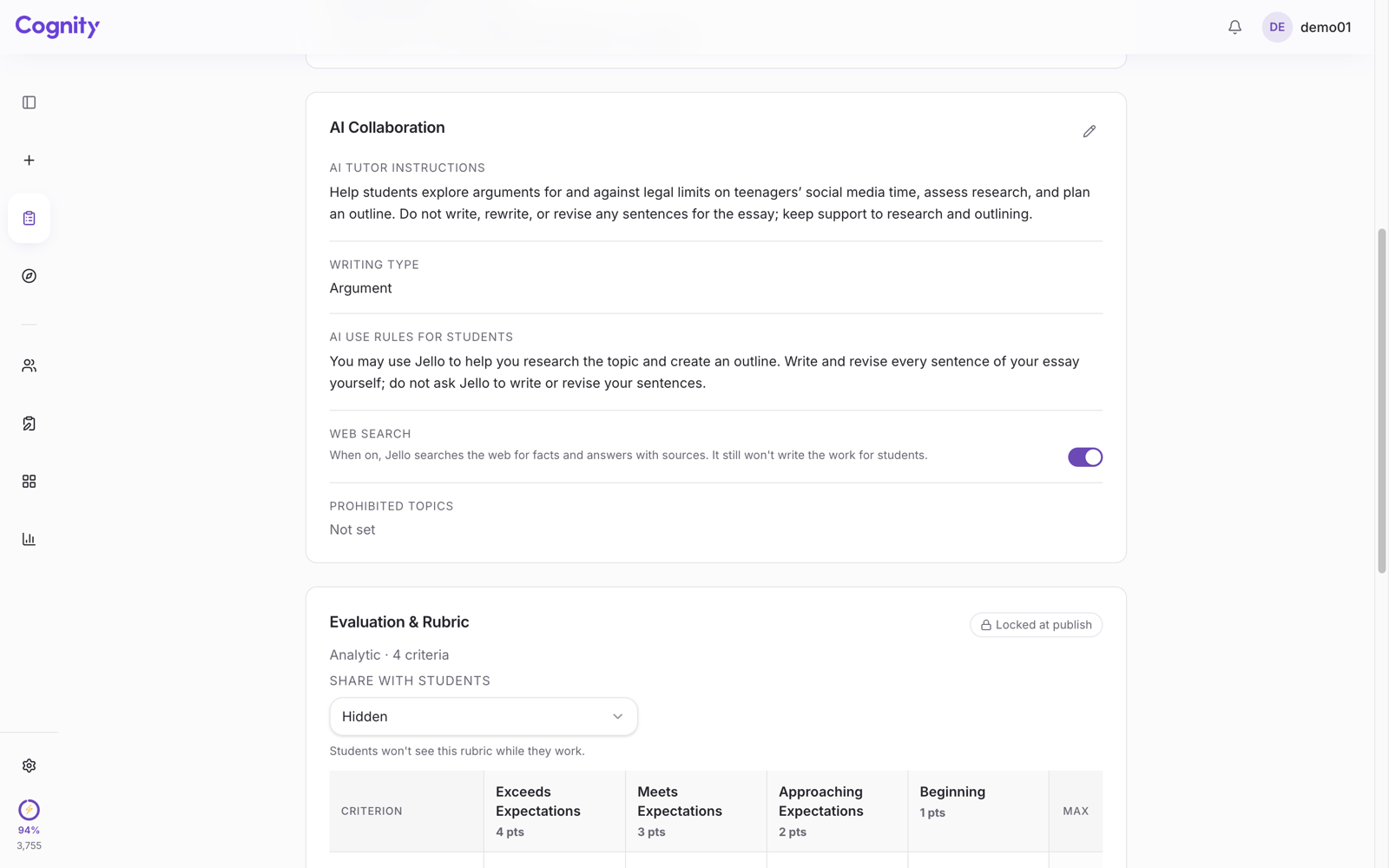
The same AI use is legitimate in one task and undermines another. Require teachers to state, on each assessed task, what AI may and may not do for that task, with one example of each.
A school-level policy that does not require this will be applied inconsistently across departments, and students will notice. How to write those rules: How to write AI rules for one assignment.
4. Is there a way to see, not only to declare?
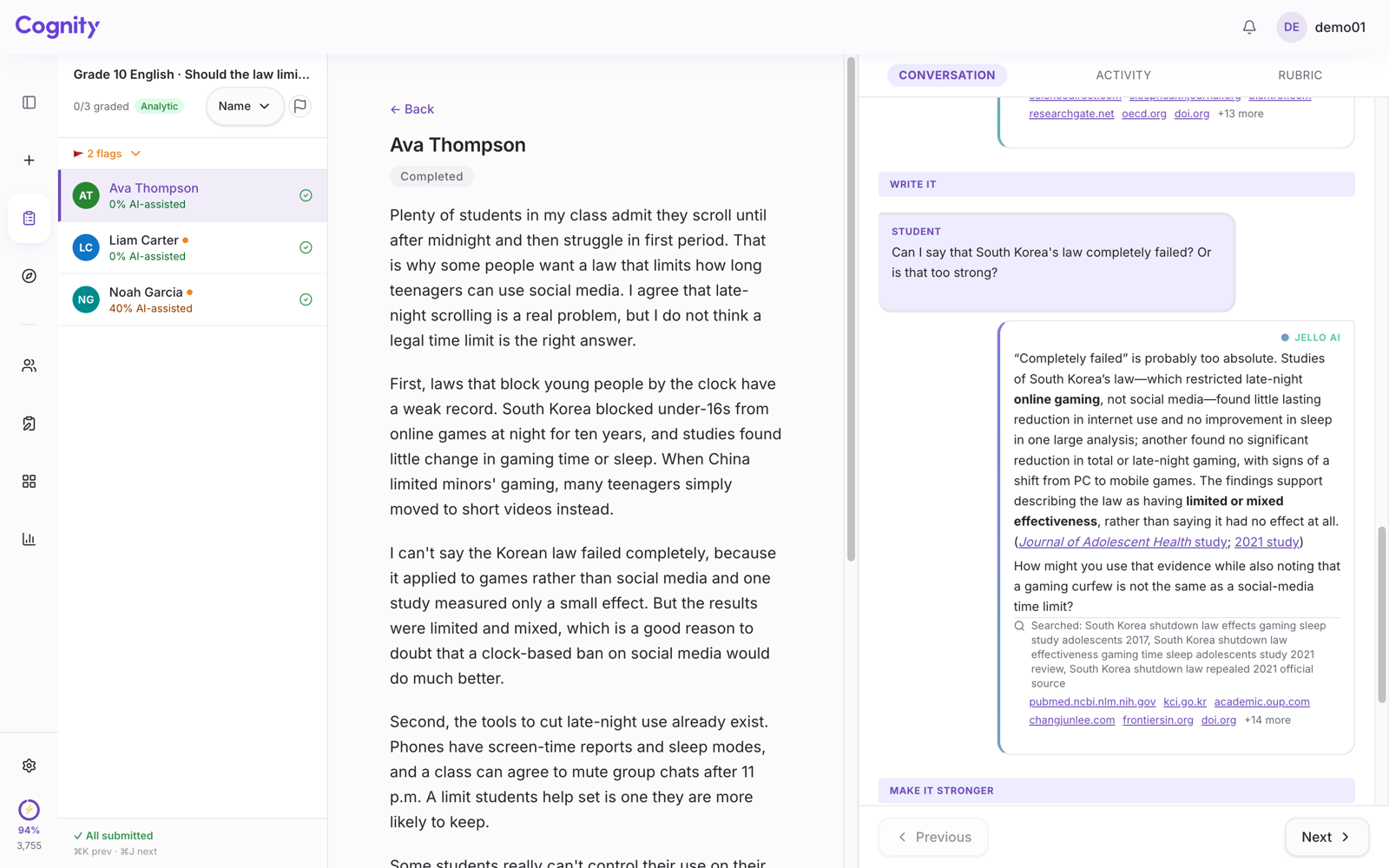
Decide how a teacher checks an acknowledgement, and name it in the policy. An acknowledgement is a student's statement, and teachers need to know what evidence they are entitled to ask for.
Options, from lightest to most complete:
- A process statement students write
- Document version history
- A workspace where the AI conversation is recorded alongside the work
The IB's own test for authenticating coursework starts from the same place: the teacher has seen the student develop the work over time, and the student can explain it.²
5. Has the policy ruled out detector scores as evidence?
Say it explicitly. AI detectors misfire disproportionately on students writing in a second language: in one study, all seven detectors tested misclassified essays by non-native English writers as AI-generated.³ In an international school, that is many of your students.
The IB itself says detection tools are likely to be a while from being reliable enough to be the sole evidence of misconduct, and a percentage is not evidence of anything the IB asks you to verify.² A policy that is silent on detectors will have teachers using them.
6. Is the process for a suspected case described as a conversation first?
Before any misconduct procedure, the teacher should be able to sit down with the student and the record and ask them to explain a specific moment. Write that step in. It resolves many cases, and it is the step that teaches.
The IB takes the same line: it would rather students can speak about their work with their teachers than be accused on the basis of small differences in the predictability of their word choices.²
7. Do students see the policy where they work?
A policy document is something students read once. The assignment-level rules from point 3 should appear on the task itself, every time.
8. Is there a plan for the case the policy did not anticipate?
There will be one within the first month. Name who decides (usually the coordinator with the teacher), and commit to adding the decision to the policy as an example. Policies that grow by cases stay usable.
9. Is the policy reviewed against what actually happened?
Set a date, one term out, to look at real cases and adjust. The IB's own guidance has been updated as the tools changed; yours should too.¹
How can Cognity cover points 3, 4 and 7?
Points 3, 4 and 7 are where many policies quietly fail, because they require something to exist at the assignment level: rules the student sees, and a record the teacher can read. Cognity, a classroom AI workspace, is built for exactly that.
A teacher writes the AI rules for a task, the rules are shown to students and followed by the AI assistant they use, and every prompt, response and revision is recorded so the acknowledgement becomes a summary the teacher can check against the log.
For a coordinator, that means the IB's crediting requirement can be checked against a record rather than taken on trust. More on this at Cognity for IB and advanced schools.
If you want to see what an IB-style task looks like with a process record, Cognity is free for individual teachers.
FAQ
Does the IB allow students to use AI?
Yes. The IB says it will not ban AI software. It requires that AI-generated work included in an assessment is credited in the body of the text and referenced in the bibliography.¹²
Can an AI detector score be used as evidence of IB misconduct?
It should not be. The IB says detection tools are some way from being reliable enough to be the sole evidence of misconduct, detectors are least reliable on students writing in a second language, and a percentage does not show whether AI content was credited, which is what the IB asks you to verify.²³
For the wider case against detector scores, see alternatives to AI detectors.
Sources
- International Baccalaureate, Artificial intelligence (AI) in learning, teaching, and assessment, last updated 19 February 2026. Checked 29 September 2026.
- International Baccalaureate, Academic integrity policy (PDF), Appendix 6: Guidance on the use of artificial intelligence tools. Checked 29 September 2026.
- Liang, W. et al., GPT detectors are biased against non-native English writers, Patterns, 2023. Checked 29 September 2026.
For what the IB expects when a teacher authenticates an EE or IA, and the evidence to keep, see how teachers authenticate EE and IA work.
This article was developed independently from and is not endorsed by the International Baccalaureate Organization. International Baccalaureate, Baccalauréat International, Bachillerato Internacional and IB are registered trademarks owned by the International Baccalaureate Organization.