An AI acknowledgement template for IB and international schools

An IB-compliant AI acknowledgement names the tool, says what it was used for and what it was not used for, marks any AI-derived text in the work, and lists the tool in the bibliography. The IB requires AI-generated work to be credited in both places.¹ Copy the one-paragraph template below and adapt it to your school's policy.
Many international schools have written an AI policy to match the IB's requirement. The part that tends to be missing is the mechanics: what exactly does a student write, and how does a teacher check it? This is a working template, not legal advice.
What should a student's AI acknowledgement say?
Ask students to include this at the end of any assessed work:
AI use statement. I used [tool name, e.g. ChatGPT / the class AI assistant] for this work. I used it to [brainstorm ideas / get feedback on my draft / check grammar / explain a concept / other: ________]. I did not use it to [write sentences that appear in this work / generate my argument / other: ________]. Where text or ideas from the AI appear in this work, I have marked them [in brackets / with a footnote] and listed the tool in my bibliography. [Optional: I have attached my conversation log.]
Four things make this work better than a yes/no checkbox:
- It names the tool.
- It names the purpose, which is what the IB and many school policies actually care about.
- It states the negative, which forces the student to think about the line.
- It points to evidence, which is where the template stops being a promise and starts being verifiable.
How do students cite AI in the bibliography?
Follow the citation style your school already uses. The IB's guidance asks that AI-generated text in the work is in quotation marks, and that the citation includes the prompt given to the AI tool and the date the text was generated.² A workable general form:
OpenAI. (2026). ChatGPT (Sept 2026 version) [Large language model]. Prompt: "Give me three arguments about…" Response retrieved 12 Sept 2026.
A bibliography entry for AI with no date and no prompt tells the reader nothing.
How should a teacher check an AI acknowledgement?
Run through five questions:
- Does the statement name a tool and a purpose?
- Does the stated purpose match what the assignment allowed?
- Is any AI-derived text actually marked in the work?
- Is there a bibliography entry, with a date and the prompt?
- Is there any evidence beyond the student's word?
The last question is the hard one, and it is where many policies quietly fail. A statement that says "I used AI for brainstorming only" is unverifiable if the brainstorming happened in a tab you never see.
The IB's own test for authenticating coursework points the same way: the teacher has seen the student develop the work over time, and the student can explain it.²
How can you make an AI acknowledgement verifiable?
The cleanest way to make an AI use statement verifiable is to have the AI use happen somewhere that keeps a record. When students work with an AI assistant inside the same workspace where they write, the record is generated as they work: every prompt, every response, every revision, in order.
The acknowledgement then stops being a paragraph the student composes from memory and becomes a summary the teacher can check against the log.
This is how Cognity, a classroom AI workspace, is built. The teacher sets what the AI may do for a task (coach but not write, for example), students join by link, and each submission arrives with its process record and the Authorship panel.
For an IB coordinator, this means the acknowledgement can be checked against a record instead of taken on trust, and a teacher who is asked "how do you know?" has an answer that is not a probability score.
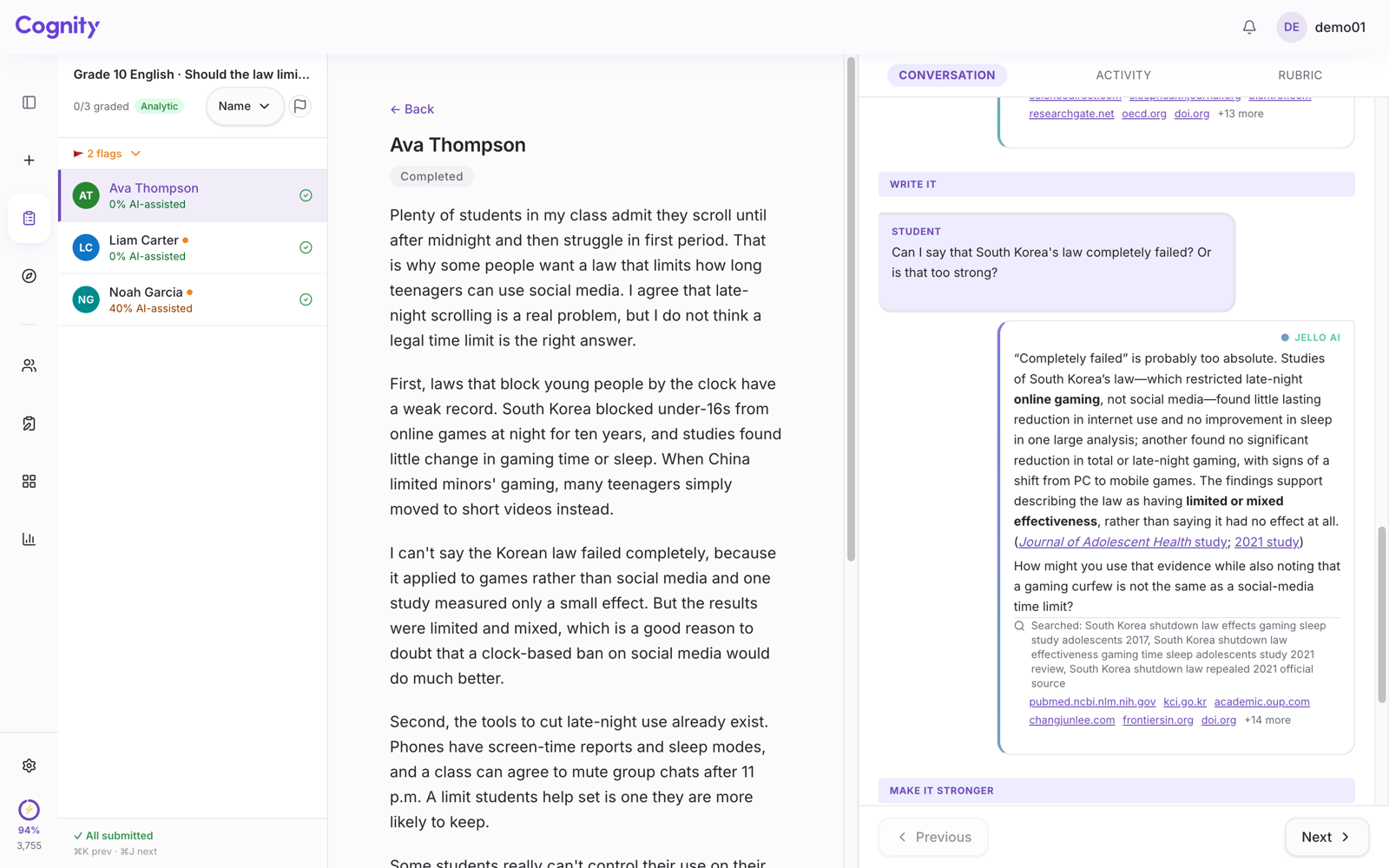
To see what else Cognity records for an IB school, from the full prompt and revision history to the teacher's process review, look at Cognity for IB and inquiry-led schools.
Should you check acknowledgements with an AI detector?
No. Detectors misfire disproportionately on students writing in a second language: in one study, all seven detectors tested misclassified essays by non-native English writers as AI-generated.³ A score is not evidence of anything the IB asks you to verify.
The IB itself says detection tools are likely to be a while from being reliable enough to be the sole evidence of misconduct.² If your policy says "we will check for AI use," the check should be a record, a conversation, or both.
If you want to see what a process record looks like in an IB-style task, Cognity is free for individual teachers. Set a task, share the link, and read the first record when it comes in.
FAQ
Does the IB require a specific citation format for AI?
It asks you to use the referencing style your school already uses, with AI-generated text in quotation marks and the prompt and the date in the citation.² Name the tool as well.
Is a yes/no AI checkbox enough?
No. A checkbox does not say what the AI was used for, which is what the IB and many school policies care about. The statement should name the tool, the purpose, and what it was not used for.
For the policy this template sits in, see the IB AI policy checklist for coordinators, and for how Cognity works in IB schools, Cognity for IB and advanced schools.
Sources
- International Baccalaureate, Artificial intelligence (AI) in learning, teaching, and assessment, last updated 19 February 2026. Checked 29 September 2026.
- International Baccalaureate, Academic integrity policy (PDF), Appendix 6: Guidance on the use of artificial intelligence tools. Checked 29 September 2026.
- Liang, W. et al., GPT detectors are biased against non-native English writers, Patterns, 2023. Checked 29 September 2026.
This article was developed independently from and is not endorsed by the International Baccalaureate Organization. International Baccalaureate, Baccalauréat International, Bachillerato Internacional and IB are registered trademarks owned by the International Baccalaureate Organization.